
The Changing Environment During the Peterson Years
From Countdown Acid Rain and province-wide Blue Box programs…to increased enforcement and penalties, Lifelines for water and sewer systems, regulating the Municipal Industrial Strategy for Abatement (MISA), and signing the Niagara River Accord… through to creation of the Rouge Provincial Park and banning (o)Zone depleting substances, Ontario’s Liberal government from 1985-1990 tackled and acted on an unprecedented range of environmental issues.
Under Premier David Peterson’s management, the open transparency, evidence-based approach, and modernization that generally characterized the new government applied equally, and specifically, to the Ministry of the Environment (MOE). Still, how did so many changes to environmental protection happen so quickly?
By 1985, significant changes underpinned the province and its electorate. Peterson credits his predecessor, Stuart Smith, for advancing the Liberal Party’s urban outreach and environmental focus which allowed his own campaign to target middle class (sub)urban voters, notably women and ethnic communities, to expand further from its historical rural base. These voters were more progressive and recognized the threats from major international environmental disasters like Union Carbide’s 1984 chemical release in Bhopal (India) and Love Canal in nearby New York.
They increasingly learned about provincial environmental issues championed by groups like the Canadian Environmental Law Association (CELA), the Canadian Environmental Law Research Foundation (CELRF), Great Lakes United, Pollution Probe, Greenpeace, and the Canadian Coalition on Acid Rain (the Coalition). And local organizations and personalities like Jim Robb at Save the Rouge Valley and Margherita Howe’s Operation Clean (Niagara) energized communities.

“Without an Environment Commissioner and ‘environmental bill of rights’ in place at the time,” notes Jim Bradley in a recent discussion,” groups and communities relied on an emerging coterie of strong environment-beat-reporters and Queen’s Park Gallery journalists to communicate their stories and deliver their messages.” Writers like Michael Keating, Christy McLaren, Peter Gorrie, Ross Howard, David Israelson, Doug Draper, Rosemary Speirs, Richard Brennan, and others became household names along with their television counterparts like Robert Fisher and Steve Paikin.
A mid-election PCB spill
Voters grew tired of denials and excuses from polluters, along with the Tory government’s more contained management approach. Then Environment Minister Morley Kells’ unfortunate remarks that you’d only be subject to harm “…if you were a rat licking the highway,” following a 1985 PCB spill on a northern highway typified the Tories’ approach under then Premier Miller and vaulted ‘environment’ to a leading top-of-mind issue in major public opinion polls.
Fortunately, strong economic growth during the 1983-1989 period resulted in steady government revenues to pay for active environmental policy and programs (‘pay to play’ according to Treasurer Bob Nixon).
The transformation underway from a manufacturing to knowledge-based service economy and influenced by the Premier’s Council initiatives and trading partner mission shifts to Western Europe and the ‘4 Tigers’ also affected the topics and tenor of the province’s environmental policy debate. ‘Action’ simply described the agenda demanded by Ontarians and ‘activist’ described the Liberal government on the environment and other policy areas.
A New Team in Town
Peterson appointed Jim Bradley as Minister of the Environment in his first Cabinet, raised the stature of the Ministry itself to a senior one with a role on the agenda-setting Policy and Priorities Board and the Management Board of Cabinet, and maintained both for the duration of the government to undertake the long-term environment policy and structural changes considered necessary. Individual issue sets did not drive the Premier per se, but as he says today, “I view, and viewed, environmental policy from a moral vantage. Permitting polluters to discharge and emit without prevention or penalty is reprehensible, as is leaving the clean-up of the province and preservation of its natural diversity to future generations.”
Bradley, himself, requested the environment portfolio. Growing up in Sudbury’s mining community, he witnessed the effects of pollution firsthand. As a resident of Niagara Region, his concerns about protection of tender fruit and agricultural lands along with the Niagara River dominated. Both revealed his understanding of the linkages between portfolios and the need for a healthy environment and strong economy to co-exist.
Bradley often referred to himself as the ‘Minister of the Future Economy’. As such, Peterson felt Bradley brought both a mission purpose and strong political acumen to the job.
As with other senior personnel, such as Treasurer Bob Nixon, Education Minister Sean Conway, utility man – Murray Elston at Health/Management Board/Financial Institutions, and Attorney General Ian Scott, Peterson gave Bradley wide latitude on the environment mandate and on building his team.
Mark Rudolph, a former Liberal Research staff member, and Chief to Environment Minister Charles Caccia, met with Hershell Ezrin in May 1985 to present a detailed plan to reduce Ontario’s acid rain levels, one of the new government’s first priorities. Ezrin directed him to Bradley. Bradley subsequently hired Rudolph as Chief.
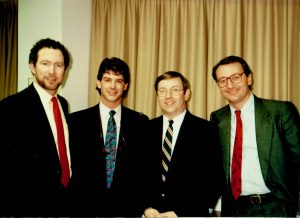
Rudolph then recruited Gary Gallon (dec. 2003) as Senior Policy Advisor given his role as the Liberal researcher prior to the election. Gallon had a long history in the environment movement beginning with Greenpeace’s formation and extensive networks.
They brought in David Oved, a Toronto Sun reporter from the Queen’s Park Gallery, known for his skepticism and tenacity, to focus communications and ‘protect the Minister.’ Future hires included Rob Milne and Ron Hoffmann to manage caucus issues and liaise with other ministries, along with strong policy advisors like Julia Langer (now at The Atmospheric Fund) from Professor Beth Savan’s Innis College program and Sarah Rang from Environmental Studies at UofT.
The team maintained strong connections to the environment community – including Gallon’s wife, Janine Ferretti, and Langer’s partner, Kai Millyard, at Pollution Probe, and Adele Hurley, a former Liberal environment and energy researcher at the Coalition. They consulted the community often for policy approaches, ‘temperature checks,’ parallel strategies, and personnel. Indeed, some ENGO members said they spent more time in the Minister’s office during that first summer of 1985, where they were invited in to ‘brief’ the Minister on issue theme weeks, than they had over 42 years of Conservative government. Together, Bradley’s team released hundreds of reports, polls, and other documents long gathering dust on MOE shelves and they engaged in each new environmental battle to be fought.
Bradley enjoyed considerable support from the government senior leadership over its two terms in office, and particularly from ‘the 51% shareholder,’ without whom the Minister could not have moved forward as aggressively as he did.
The Premier’s Office deployed Phil Dewan, and later Jan Whitelaw, to advance the agenda and liaise with the Minister’s staff ensuring alignment and near seamless communication. Policies were approved; staffing levels and programs became well resourced. In fact, the Ministry’s operating budget more than doubled to $650 million annually by 1990 from the sub $300 million per year under the previous Tory government. By comparison, today’s department operates on $332 million. Capital budgets represented additional funding.
Not everything went smoothly
Perhaps “the only less than brilliant idea in hindsight,” according to Peterson recently, occurred when he appointed Rod McLeod as Deputy Minister. Rod’s strong legal background and ambition comprised attributes that should have strengthened the quality and pacing of product from the ministry, even more than they did. Regrettably, the Deputy may have taken too literally the job of managing the ‘Four Horsemen of the Apocalypse,’ ‘Space Cadets’ or ‘Bradley Brats’ as Peterson jovially referred to Bradley and team.
This focus and reminders that ‘he went to law school with the Premier’ led to distinct acrimony between Minister and Deputy which did not always prove constructive. Whitelaw and Gordon Ashworth each maintained a ’Rod vs Jim/Mark file’ to document what became known as ‘floor wars.’ Strangely enough, in later years, McLeod turned to Rudolph to assist him and his neighbours to become ‘activists’ to protect the area near their cottages from a proposed low-level nuclear waste site.
Despite tensions at the executive level, and a political staff hired to drive the Minister’s agenda and drill down hard by questioning historical issues and practices, working relations with the department went relatively smoothly, and especially so after Gary Posen assumed the Deputy Minister role. Many public service members relished addressing longstanding environmental matters. The willingness of Bradley and his staff to hear and act on their ideas breathed fresh air into 135 St Clair Avenue.
The period became notable for innovative cooperation between the political and bureaucratic levels too. On the acid rain file, on Rudolph’s recommendation, Bradley set up the ‘A-team’ co-chaired by Rudolph and Assistant Deputy Minister Walter Giles to meet the government’s commitment to announce an acid rain abatement strategy within six months. The A-team mapped backwards from a December 1985 announcement date to lay out a time frame that incorporated negotiations with the four main emitting sources, Cabinet committee, and Cabinet approvals.
It met weekly and delivered on-time results. Similar teams followed, including the I-Team for infrastructure (Lifelines) and N-Team for the Niagara River Accord. The teams did not focus on if a policy action would be taken but on how best to achieve the decided direction and how/when to move through the government decision-making apparatus.
Throughout the period, Bradley worked closely with Opposition parties as well. The Accord guaranteed NDP support for specified environmental initiatives and certainly enabled quick action, but the Minister truly valued his critics’ input and many amendments – especially from Ruth Grier and Margaret Marland. During the majority government period, Bradley continued to consult the critics and even worked with them to ask questions to help advance progress on slow or stalled files.
Taking up the challenge
Proclamation of the Spills Bill represented the first action item for the new government. Within days of the June 26 swearing in, Bradley committed to proclaiming the legislation passed by the Tory government in 1979 but never put into effect. Under the law, when a spill occurred, the onus fell to the polluter to clean up the spill immediately with legal liability to be determined later. He established a Spills Action Centre and 24/7 hotline, an Environmental Compensation Corporation to redress those impacted, and a consultation panel to hear and address concerns from the farm, trucking and manufacturing industries. On the main barrier to acceptance, Bradley and Oved worked with a legal expert in the insurance industry, Tory Al O’Donnell. He advised them on how to establish an insurance ‘facility’ to solve outstanding availability problems in the face of a broader crisis in the insurance/reinsurance sector world-wide. Bradley proclaimed the Spills Bill on November 29, 1985, and received the ‘Hang Tough Award’ from CELA the same day.
These kinds of actions to restore public and stakeholder confidence in the Ministry of the Environment happened quickly.
Bradley moved to establish a large, independent Investigations and Enforcement Branch in August 1985 and expanded it again in 1988. He introduced legislation in 1986 to dramatically increase common and maximum penalty levels, allow jail sentences, permit the courts to strip ill-gotten gains, and create officers’ and directors’ liability. Countdown Acid Rain followed in December 1985 to a two-minute all-party standing ovation in the Legislature and top of the fold coverage in Sudbury, Thunder Bay, Toronto, Ottawa, Washington and New York.
It became a precedent for the other provinces, establishing Canada’s ‘clean hands’ position on acid rain, and led to President George H. Bush signing an amended US Clean Air Act to address American acid rain sources. The progress report requirements on the major emitters meant they could no longer avoid implementation, as they had under the Tories, and the abatement targets inspired industrial innovation.
Inco/Vale became the lowest cost nickel producer in the world and according to its own ads ‘invested $500 million in something we all believe in – clean air.’ Countdown Acid Rain marks one of the real highlights of his tenure for Bradley.
Shifting from reaction to prevention
The government’s philosophy became to ‘look at the bigger picture’ and to let science drive the policy, whether the issue was part of the government’s assigned mandate items or ones that bubbled up from the ministry or communities. Bradley shifted the Ministry focus from reaction to prevention and from one-off transactional deals with companies to sectoral regulatory approaches.
When scientists discovered a toxic chemical ‘blob’ in the St Clair River offshore from Dow Chemical in Sarnia in 1985 affecting downstream municipal and First Nation water sources, and later the ‘Huggies Headache’ with Kimberly Clark in Terrace Bay in 1987, the Ministry’s broad-based response led to the province-wide Drinking Water Surveillance Program (DWSP), Lifelines (a municipal infrastructure program for water and sewer lines), the Municipal-Industrial Strategy for Abatement (MISA), and the Kraft Paper Mill regulations.
Their monitoring regulations generated scientific data which could not be refuted and allowed the Ministry to establish abatement targets in regulations and control orders. Companies were free to choose how to meet the targets using best available technology economically achievable (BATEA), not if. To this day, Rang speaks glowingly of the dioxin research capacity established and laboratory resources expanded to ensure healthy drinking water. The team used this same approach to air pollution in 1988 with its announcement of the Clean Air Program (CAP).
Similarly, when controversy reared its head over refillable soft drink container levels and calls for deposits, Bradley and team chose an objective to prioritize the 3Rs (reduction, reuse and recycling) and reduce overall waste going to landfill, especially considering rapidly diminishing capacity in the GTA and pending closure of the Keele Valley landfill.
Instead of targeting high recovery rates for only 1% of the waste stream via deposits on soft drink containers, they rolled out a province wide multi-material Blue Box program which earned UN recognition and has been replicated around the world. The financial contributions required from the soft drink industry to share program roll-out became the first product stewardship example.
The team added student recycling in schools (the STAR program) to create mini-influencers, apartment recycling, and laid the foundation for the green bin for residential composting which later rolled out province wide under the McGuinty government.
Principled but pragmatic
Environmental struggles did not confine themselves to corporate polluters; the Premier’s Office, Bradley and team also managed internal differences between ministries and government agencies to successful environmental and other outcomes. The Minister proved principled but pragmatic. He placed the Ontario Waste Management Corporation (OWMC) under full environmental assessment, but deferred on Skydome famously declaring, “Play ball.” Ontario Hydro resisted acid rain controls at its coal-fired generating plants and initially secured a ‘banking provision’ to ensure its flexibility to provide power to Ontarians. Working with the Select Committee on the Environment, and strategically placed media stories, including Spier’s timely placement on acid rain’s impact on maple syrup production, Bradley’s team achieved Cabinet repeal of the banking provision in May 1987.
Coal generation was fully phased out during the McGuinty government. Bradley worked internally via Minister Ed Fulton to halt the Ministry of Transportation and Metro Council’s plan for the East Metro Freeway which would have cut through alongside the Rouge River Valley.
Premier Peterson announced the Rouge Valley Provincial Park in March 1990; it is now an urban national park with the Trudeau government most recently adding a further 8700 hectares in January 2025 when the proposed federal Pickering airport was finally laid to rest. And, while the government did not specifically stop the extension of the Red Squirrel Road in Temagami where protestors and Bob Rae were arrested, the trade-off meant a commitment to addressing the conflict’s underlying issues.
Legislation by Ian Scott created intervenor funding for community groups commenting on projects before the Ontario Energy Board (OEB), Environmental Assessment Board (EAB) and joint board. MNR under Minister Vince Kerrio restored Lady Evelyn Smoothwater Provincial Park to wilderness status and added three adjacent water hieroglyphic parks among a broader package of new provincial parks. MNR also revised the Provincial Park Policy (the Blue Book) to eliminate non-conforming uses in parks like forestry and mining, and it established an Old Growth Forest policy to protect these critical stands. Last, but not least, Premier Peterson and Chief Gary Potts signed a landmark agreement for joint stewardship of almost 100,000 acres with the Teme Augama Anishinaabe (Deep Water People).
Looking to the future
The Peterson government kept its eye on the horizon, not content simply to address problems of the day. Following the Brundtland Commission, Bradley and Elston championed Ontario’s first Roundtable on Environment and Economy stressing sustainability over a zero-sum choice to position the province for a strong future.
Building on a successful international conference in Montreal in 1987, the government passed the first legislation in Canada to ban ozone depleting substances and hosted the Mulroney government’s first international conference on addressing climate change in Toronto in 1988.
While the Peterson government didn’t get everything done that it wanted to, today Peterson reflects on the achievements with pride and says, “we were doing a good job, doing the responsible thing.”
Bradley has only two main regrets: that the Hagersville tire fire, started by arsonists, occurred before the provincial tire recycling program became operational and the unproven ‘tainted fuel scandal’ promoted by reporter Jock Ferguson festered for so long.
Still, Bradley and team laid down a remarkable legacy of change and established the tenets for policy development and implementation that hold true for future practitioners. These principles may prove most valuable when as a civil society we confront the current trend to policy reversals and deregulation underway today.