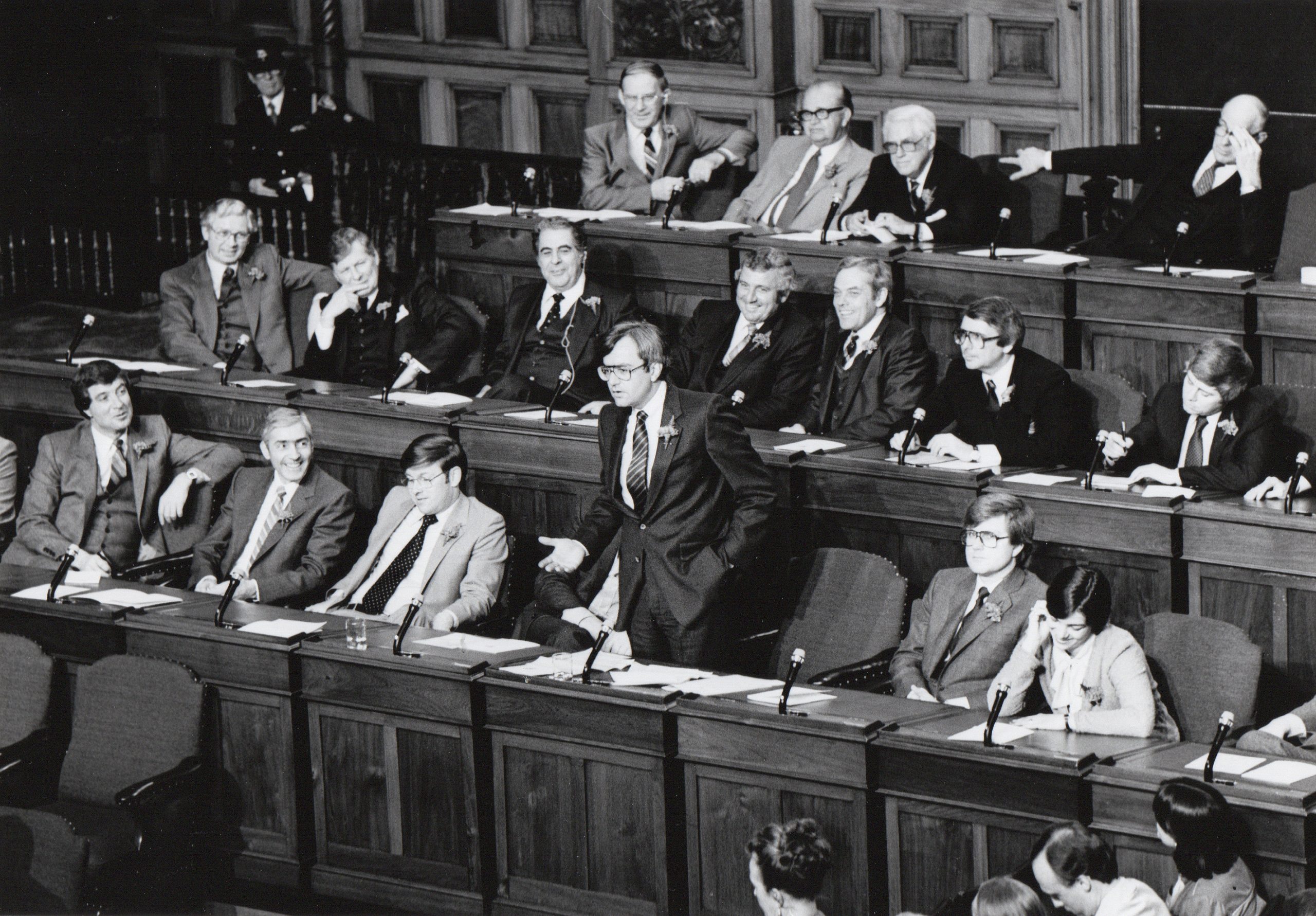
Making a more effective Legislature for its members and the public
More power for individual MPPs, stronger committees, greater accountability and introducing television to the legislature all helped the public better understand governing in Ontario
Among the reforms brought in by the Peterson government were a number of significant improvements to the formal procedures of the legislature and to its overall operation. Some had been promised in the Accord; other emerged over the Liberals’ time in office. Particularly notable were the introduction of “electronic Hansard” – TV in the House – and measures to strengthen committees, though a host of lower profile procedural changes made for a more effective legislature, promoting accountability, empowering MPPs and making better use of House time.
The Peterson reforms are best understood as a second round of important reforms instituted during the Conservative minority of 1975-81. Decades of Tory majority rule had been characterized by minimal change in the legislature and by frequent government recourse to bulldozing the opposition rather than respecting its legitimate function. Tellingly, the massive government restructuring wrought by the Committee on Government Productivity, instigated by John Robarts in 1969 and implemented throughout the 1970s by Bill Davis, did not extend to the legislature. Thus when gifted with a minority situation following the 1975 election, the opposition Liberals and New Democrats pushed successfully for a wide range of far-reaching reforms, encompassing modernized procedures and greatly improved resources for individual MPPs, committees and parties. The Peterson reforms to the legislature were not as sweeping as those from the Davis minority, but did mark significant advances. The Conservative majority in 1981-85 did not rescind any of the earlier changes but neither did it engage in reform.
Televising the proceedings
Unquestionably the highest profile reform and arguably the one with the most lasting substantial influence was bringing full-time television broadcasting of high technical quality to House proceedings. Television had been present in the House for some time: CBC routinely installed large cameras over the doors from the Chamber to the government and opposition lobbies for major events such as the Speech from the Throne and the Budget. More significant were the bank of TV cameras, often half a dozen or more, each with reporter and cameraman, arrayed across the Speaker’s Gallery. Valuable as it was for the media to be able to film legislative proceedings for the 6 o’clock new, this arrangement was fraught with problems. The technical quality was at best mediocre with limited camera angles: a Tory minister whose seat was near the main door to the Chamber once begged the Speaker’s indulgence for not addressing him directly as protocol demanded by reading a statement while looking up at the cameras, explaining that whenever his mother saw him on TV all she could see was his bald spot.
Some members and staff quailed at the lack of control over what the cameras took in: one newscast included shots of an unfortunate lobbyist who had dozed off during Question Period. Worst of all, as Question Period wound down, to a one the cameras and reporters noisily decamped from the Speaker’s Gallery to set up in the lobby for scrums with ministers and opposition leaders, so that coverage of anything other than Question Period was non-existent.
Ending the desk-thumping
Fulfilling an Accord commitment, the government approved and properly funded a system of remotely controlled cameras, providing high quality images and full coverage of all proceedings. The electronic Hansard was controlled by the House, which imposed a set of restrictive rules, such as a prohibition against showing any but the MPP speaking, regardless of what else was happening elsewhere in the Chamber. Overall, members and the public welcomed the advent of TV in the House, for its obvious benefits in bringing the legislature into people’s living rooms. Other effects – some not apparent for years – were less obviously beneficial.
Traditionists mourned the eventual switch from desk-thumping to applause because “it didn’t look good on TV.” More significantly, the availability of free, good quality coverage was a factor contributing to the decline in the number of journalists assigned to cover Queen’s Park. And once members could follow what was going on in the House from their offices, they became less inclined to spend time in and around the Chamber, reducing interactions with other members, especially those from other parties, an important element in maintaining civility in the House.
Greater independence for committees
Over time, as promised in the Accord, legislative committees were strengthened. Greater staff resources were made available to them and they were given the authority to set their agendas, rather than waiting for House permission. Important new committees were established. Following a proposal in Treasurer Bob Nixon’s October 1985 discussion paper Reforming the Budget Process, a Finance Committee was created to review the province’s economic situation, the government’s fiscal policy and related matters and to hold pre-budget consultations. A Government Agencies Committee continued the previous work of the Procedural Affairs Committee in reviewing the operations of the province’s myriad agencies, boards and committees but with a new mandate to vet top-level appointments.
A major step forward entailed the overhaul of the legislature’s procedures for reviewing the estimates, the government’s spending plans. Earlier proposals to improve the existing process, universally condemned as a colossal waste of time and resources, had gone nowhere. In place of several committees devoting literally hundreds of hours to the estimates yet offering precious little value beyond allowing opposition MPPs to pursue individual hobbyhorses and raise occasional constituent concerns, a new Estimates Committee was established in July 1989. While the prospects of the committee actually reducing expenditure items remained at zero, debate became better focused and ministers, MPPs and public servants spent less but more productive time on estimates review.
Not all reform proposals on the table went forward, as, unlike some that succeeded it, the Peterson government only proceeded with important change with substantial opposition agreement. However, among the noteworthy reforms were the adoption of a secret ballot for the election of the Speaker together with the long-overdue abolition of challenges to the Speaker’s rulings; the end of emergency debates, replaced with Ottawa-style opposition days; the introduction of an opportunity for private members to make short statements before Question Period; the establishment of a ‘parliamentary calendar’ making for predictability in the scheduling of legislative sessions; and a number of minor ‘inside baseball’ procedural changes to improve House operations.
Not without controversy
One controversial change could not be characterized as a “reform” but it did represent notable modernization. Many Liberals and New Democrats had long believed that Roderick Lewis, the Clerk of the House – the Speaker’s principal advisor and key figure in House administration – was overly partial to the Conservatives. Aside from possible partisan taint, Lewis was unquestionably conservative when it came to legislative reform. Then in his mid-70s, Lewis had held the Clerkship since 1955, having replaced his father in the position. His retirement had seemingly been arranged, but Lewis decided to hang on demanding a lavish retirement package,
claiming that a provision in the Legislative Assembly Act gave him the position for life. Following an unseemly and very public brouhaha bringing credit to no one, Lewis left, replaced by an activist, bilingual House of Commons veteran, Claude DesRosiers. Shortly after DesRosiers’s appointment, the contract of the legislature’s Director of Administration, Robert Fleming, whose ways generated enmity among members, was not renewed, leaving the Clerk clearly in charge of the burgeoning legislative bureaucracy.
The decades the Liberals had spent in opposition at the mercy of a sometimes capricious government inclined them to favour legislative reform. To be sure, they did not give away the store to the opposition and left promising reform proposals unfulfilled. On occasion, faced with relentless opposition obstruction to key legislation, they had recourse to draconian time allocation and related measures, but only as a last resort when other options proved unworkable. Unlike later governments, they did not impose far-reaching, systematic restrictions on MPPs’ capacity to do their jobs through massive omnibus bills, routine use of closure motions and severe time limits on debate. All told, the Peterson government’s record on legislative reform was substantial and positive.