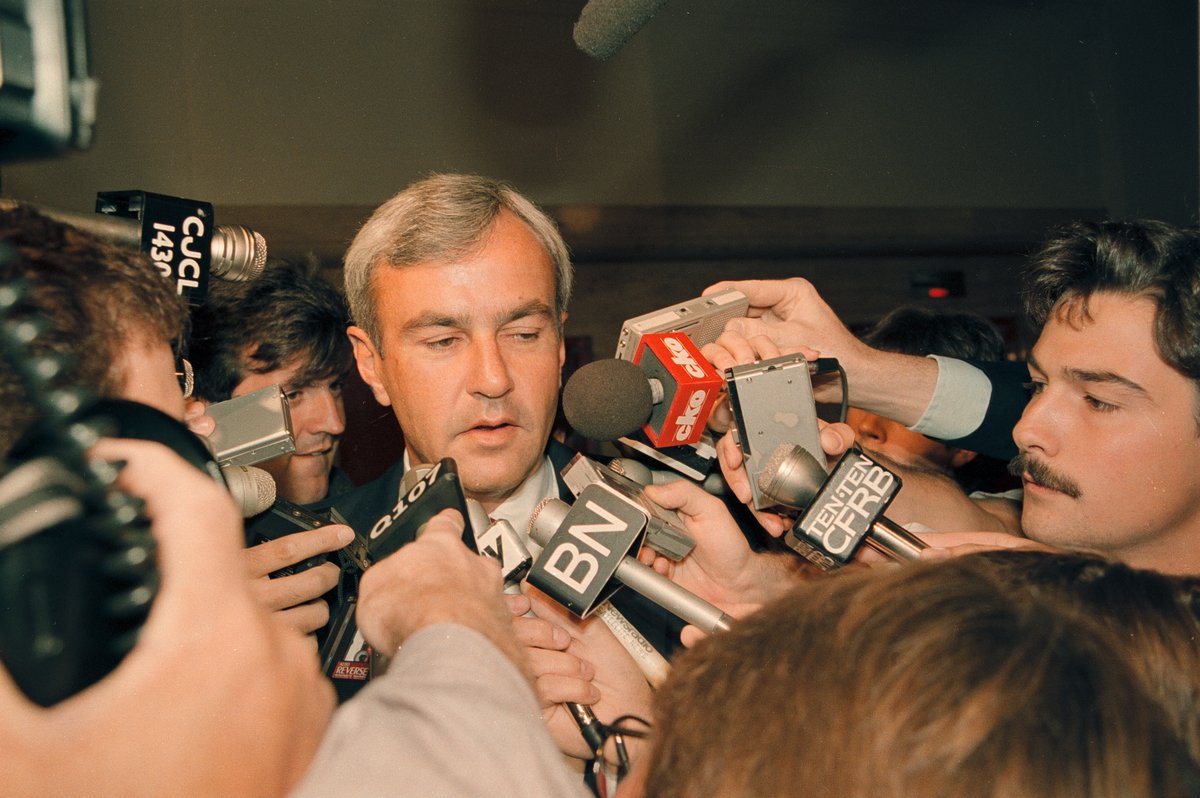
Polling during the Peterson years – When popularity is not enough
It must be a nice feeling to be Premier of Ontario with the opinion polls reporting that your party enjoys the support of almost 50 percent of the population – especially in a three-party system where the two opposition parties split the remainder of the vote. You can breathe easy and take your time. Victory at the next election, whenever it may come, would seem like a sure thing. Afterall, public preferences rarely reverse overnight.
If this is what you might be thinking right now, perhaps it would be wise to book a dinner date with former Premier David Peterson. Peterson can explain to him the difference between “rarely” and “never.” For most of his six years in office, Peterson’s Ontario Liberal Party enjoyed a healthy 20-point lead in the polls over its closest rival (alternating between the Progressive Conservatives and the New Democrats). In the summer of 1990, the Environics Focus Canada survey found that the Liberals attracted the support of 56 percent of the province’s decided voters, compared to only 23 percent for the NDP and 19 percent for the PCs. Sixty percent of Ontario voters said they were satisfied with the provincial government, and 58 percent approved of the way Peterson was handling his job as premier. Two months later, Peterson and his party were out of power, having lost the snap election held on September 6.
Looking over the survey results from the Peterson years with the benefit of hindsight, there are two ways to tell this story. The first is the more generous: no one could have foreseen such a stunning reversal of fortunes. The popularity of Peterson’s Liberal Party had grown steadily, starting prior to the 1985 election, and continuing after the defeat of the decades-old PC government and the formation of a Liberal minority government, and then the winning of a majority government two years later. While it dipped somewhat in the late 1980s, as it does for most governments after an initial honeymoon, the party never came close to giving up its lead. And over the first half of 1990, the party’s popularity started to grow again. The wind appeared to be in the Liberals’ sails.
Other survey questions paint a similarly encouraging picture. Majorities of Ontario voters approved of the government’s performance in health care, education, and social services. In none of these areas was approval trending downwards in the months leading up to the 1990 election. In fact, in the summer of 1990, no other provincial government had as high an approval rating as did Ontario’s in the area of health care. Fewer approved of the way the government was handling the protection of the environment – an issue that was increasingly on the public’s mind at the end of the 1980s – but the 45 percent approval rating on this issue earned in 1990 was considerably higher than where it stood a year earlier. In short, in some of the key areas of provincial responsibility, the Peterson government was still improving its standing in the public’s mind well into the mandate it won in 1987.
But it is possible to relay a second version of events, one focused more on the economy. Simply put, over a two-year period covering 1989 and 1990, the Canadian public’s assessment of the economy steadily and dramatically worsened. Several survey questions pick up this shift. The economy displaced national unity and the environment as the public’s top concern. The proportion of Ontarians worried about the economy doubled, from 40 percent in 1988 to 78 percent by the end of 1990. And most notably, the proportion of Ontarians who said the Canadian economy was getting weaker more than quadrupled, from only 15 percent in early 1989 to 64 percent just before the provincial election in 1990.
The decision to call as election for September 1990 thus came at a time when the public’s mood on the issue that arguably matters most to voters – their own economic well-being – was clearly souring.
Against this backdrop lurked two additional, high-profile issues that were unnerving the public. The first was free trade. The Canada-U.S. Free Trade Agreement, having been the main topic of debate in the 1988 federal election, came into force at the start of 1989. Most Ontarians opposed the agreement at the time, and only 28 percent expected it to strengthen the country’s economy – a figure that was lower than that in any other region. Peterson and his government were not responsible for the federally-negotiated agreement and had opposed it during the federal election campaign. But by 1989 and 1990, its coming into force was contributing to Ontarian’s fast-growing economic pessimism.
The second was the Meech Lake Accord. The drama surrounding the Accord, from the high in 1987 when the deal was reached in principle, to the low of 1990 when it collapsed after it failed to be ratified by all ten provinces, unfolded during Peterson’s tenure as premier. By the time the Accord began to unravel, it was unpopular in Ontario – as it was everywhere in the country outside Quebec. Peterson was an outspoken champion of the deal, but his efforts to keep it alive landed him offside with voters – not just because they didn’t share his position, but also perhaps because he was seen to be focusing on something that had become less of a public priority than the state of the economy.
Given the events unsettling the public mood by mid-1990, it is easy in hindsight to say that any incumbent government should have been wary about calling an election earlier than necessary. But David Peterson and his government were never unpopular during their time in office – at least, not until the 1990 election campaign itself unfolded. Peterson’s own approval rating just before his defeat was 35 points higher than that of Bob Rae prior to his defeat in 1995, and 20 points higher than that of Ernie Eves prior to his defeat in 2003.
Public preferences, however, can and do change quickly – sometimes, seemingly overnight. It is a hard lesson that David Peterson likely would gladly share with any sitting premier today.
The public opinion data cited in this article are from the Environics Focus Canada quarterly surveys. The author would like to acknowledge the research assistance provided by Grace Pfeffer in retrieving and organizing the data.