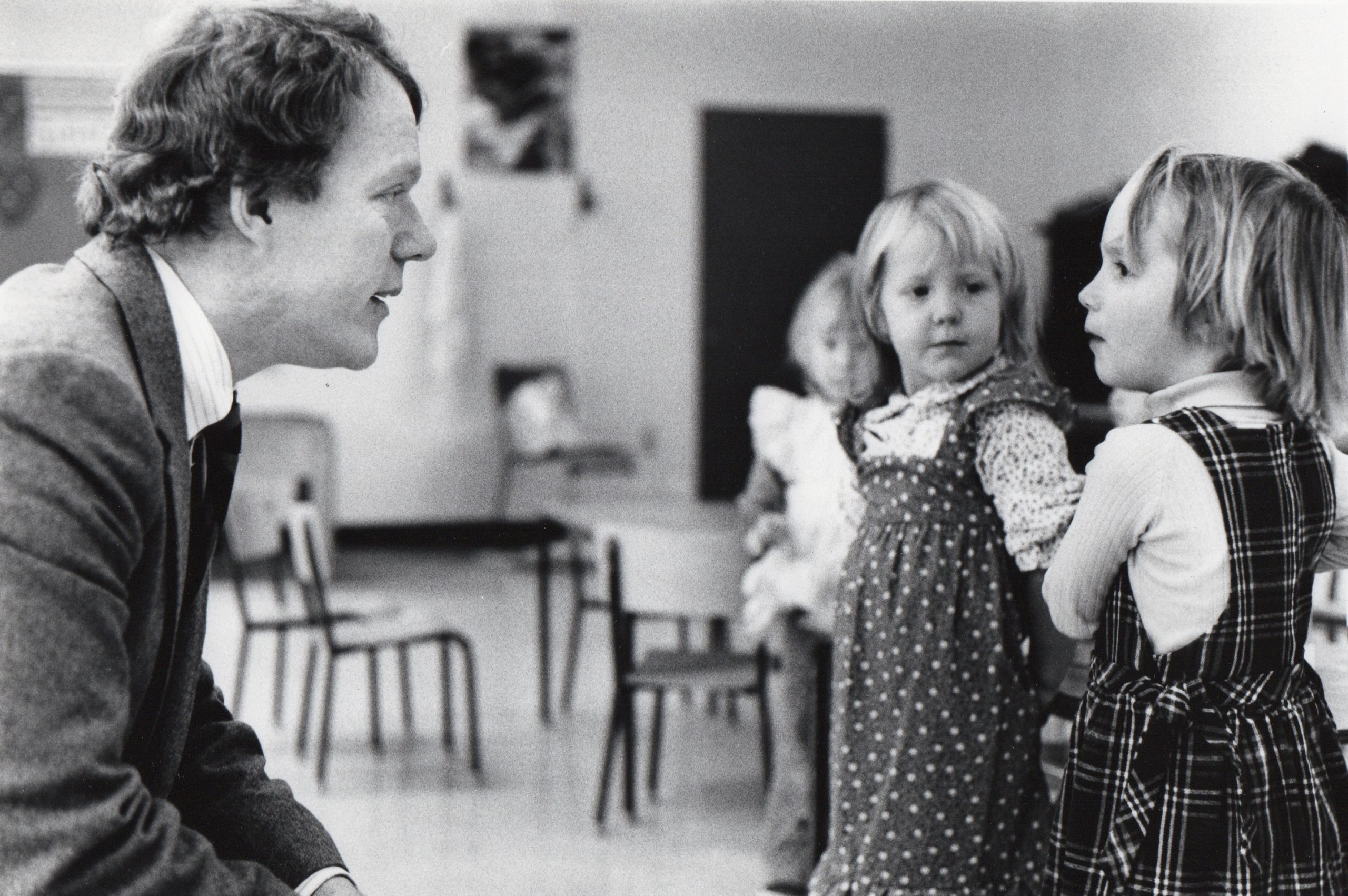
Expanding Child Care for Families
The needs of families changed significantly by the 1980s. Rising divorce rates, more women entering the workforce, and many families relying on two incomes all put pressure on existing child care options. The Peterson Government viewed child care and early-childhood education as one of the most pressing social and economic issues facing Ontario families and began to overhaul the existing system.
National Child Care Delays
By the time the Peterson Liberals formed government in 1985, a national child care program had been on Canada’s political agenda for years. It began as a recommendation of the 1970 Royal Commission on the Status of Women and was later transformed into a federal Liberal Ministerial Task Force on Child Care led by sociologist Katie Cooke.
When Brian Mulroney’s Progressive Conservatives formed a massive federal majority government in 1984, they allowed the Task Force to continue with its work despite its Liberal origins. The support for the Task Force was short-lived, however, as it was ultimately shelved by the Mulroney Government in 1987 in favour of a Special Parliamentary Committee on Child Care, delaying any implementation of a national program.
Provincial Action on Child Care
By the spring of 1987, the Peterson Government had been in power for nearly two years and had delivered on many of the promises laid out in its previous election platform and subsequent legislative Accord with the NDP. The Premier and his Cabinet began considering what they could achieve with a fresh mandate.
On April 28, 1987, the Peterson Government released a Throne Speech that telegraphed their growing ambition. A lengthy passage was dedicated to the growing need for child care in the province and stated, “The absence of an adequate supply of quality, affordable child care may be the single greatest obstacle preventing many families from realizing their full economic potential.”
The government acknowledged the possibility of a national partnership on child care that would allow for a cost-sharing agreement in the province. It argued that the federal government’s role should be to demonstrate “financial leadership” while the provinces should focus on delivery and “assume their role in ensuring that quality child care is provided to all who need it.”
While the provinces waited for a national framework, the Peterson Government decided to act more quickly and “introduce a comprehensive policy that recognizes child care as a basic public service, not a welfare service.”
The government committed to increasing the supply and range of services available while also providing direct operating funding to new and existing nonprofit agencies to stimulate sector development. While it committed to continuing support for existing private-sector agencies, it also committed to providing incentives to encourage private agencies to convert to nonprofit centres.
For child care expansion to work, the government understood that centres must be accessible to all types of communities. The Throne Speech laid out a commitment to build child care spaces in all new schools, to work with municipalities to require child care centres in new commercial buildings, and to encourage employers to offer child care services to their employees.
New Directions for Child Care
On June 4, 1987, Community and Social Services Minister John Sweeney released the landmark plan, New Directions for Child Care, to quickly expand the delivery of child care in Ontario over three-year planning cycles. The plan boosted child care funding by $26 million in the program’s first year and would go on to double total child care funding by the end of the first three-year planning cycle.
Sweeney summed up the importance of this work by stating, “All of us together are making an investment in our future — our children. The degree of our success will be measured in the well-being of the adults of tomorrow. This plan is a cornerstone of this government’s commitment to the preservation and enhancement of the family into the 21st century.”
As part of the plan, the government prioritized funding for non-profit and municipal childcare providers over commercial for-profit operators. It also began providing direct operating funding to childcare centres to help boost childcare workers’ wages. As a result of these investments, the province’s available subsidized childcare spaces quickly doubled, increasing from 20,000 to 41,000. The plan also increased the total number of licensed spaces from 74,300 to 118,200.
Just as important to the government as investments in the construction and operation of new child care spaces was the accessibility of those spaces. As he launched the New Directions plan, Sweeney was particularly concerned with addressing the needs of contemporary families, including single-parent families and those in rural communities.
As a result, he directed that child care eligibility requirements be changed from a needs-based system to an income-tested system. He argued, “Income testing is considered a simpler and less intrusive system. Together with the subsidy increases, we believe that this will make child care more affordable for a larger number of Ontario families, especially for farmers, who tend not to qualify under a needs test.”
The Peterson Government also recognized the risk to safety and quality posed by a rapidly expanding system. It addressed this by requiring parents to have better access to a centre’s annual licensing inspections and compliance with the Day Nurseries Act. The government also committed to creating updated child care legislation to oversee the expanded system.
Expanded childcare was not the only way the Peterson Government set children up for success from the earliest ages. It also significantly expanded kindergarten by requiring all schools to offer half-day junior as well as full-day senior kindergarten, where space permitted.
Better Beginnings, Better Futures
The April 1987 Throne Speech also committed to establishing Canada’s first policy research institute on children, youth, and families. It was envisioned as a multidisciplinary, community-based facility that would conduct applied research in public policy and involve community members, social agencies, corporations, and government.
Founded as the Canadian Centre for Studies of Children at Risk (now known as the Offord Centre for Child Studies) at McMaster University, the institute leveraged the groundbreaking research of Dr. Dan Offord, who conducted population studies across a broad range of areas affecting child and youth development.
This research included the continuation of the Ontario Child Health Study (OCHS), conducted in 1983, 1987, 2001 and 2014 as an ongoing survey of thousands of children to “determine health concerns, how those concerns related to family, community, and schooling issues, and whether children experienced reduced opportunities or success in subsequent years.”
This study informed the creation of Better Beginnings, Better Futures, a broad-based research initiative designed to support disadvantaged communities and prevent emotional, behavioural, physical and school-related problems in children. It included insights from 25 teachers, community workers, psychiatrists, psychologists, social workers, and nurses, and evaluated relevant literature and 45 prevention programs.
Minister of Community and Social Services Charles Beer was tasked with carrying out the program and argued that this new, consolidated, collaborative approach to child development would yield positive results for children, their families, and broader society.
“We all know the old saying about an ounce of prevention being worth a pound of cure. We know now that an ounce is not enough, especially for children and families who live in poverty,” he stated as he introduced the program in the legislature. “The Better Futures program is unique in that it unites the many existing prevention efforts into a consolidated approach… spotting the potential for emotional, behavioural and physical difficulties in children and correcting them before they become problems.”
That consolidated approach meant that staff in the Ministry of Health, the Ministry of Education, and the Ministry of Community and Social Services were collectively tasked with creating projects supporting the healthy development of infants, preschoolers, and primary school children, and working to teach, coordinate services, and meet the specific needs of families in select communities across Ontario. In many ways, this focus ultimately led the McGuinty government to create the new, separate Ministry of Children and Youth in 2003.
To measure the success of the program, the government planned to conduct a 25-year study of the children, families, and communities involved in the projects, with the aim of curbing juvenile delinquency, reducing teen pregnancies, lowering the high school drop-out rate, and increasing employment opportunities for young people.
The government was ultimately unable to conduct a 25-year study as it lost the 1990 election. However, the Offord Centre for Child Studies continues to operate today, producing leading research to support children and inform policy systems and care worldwide.