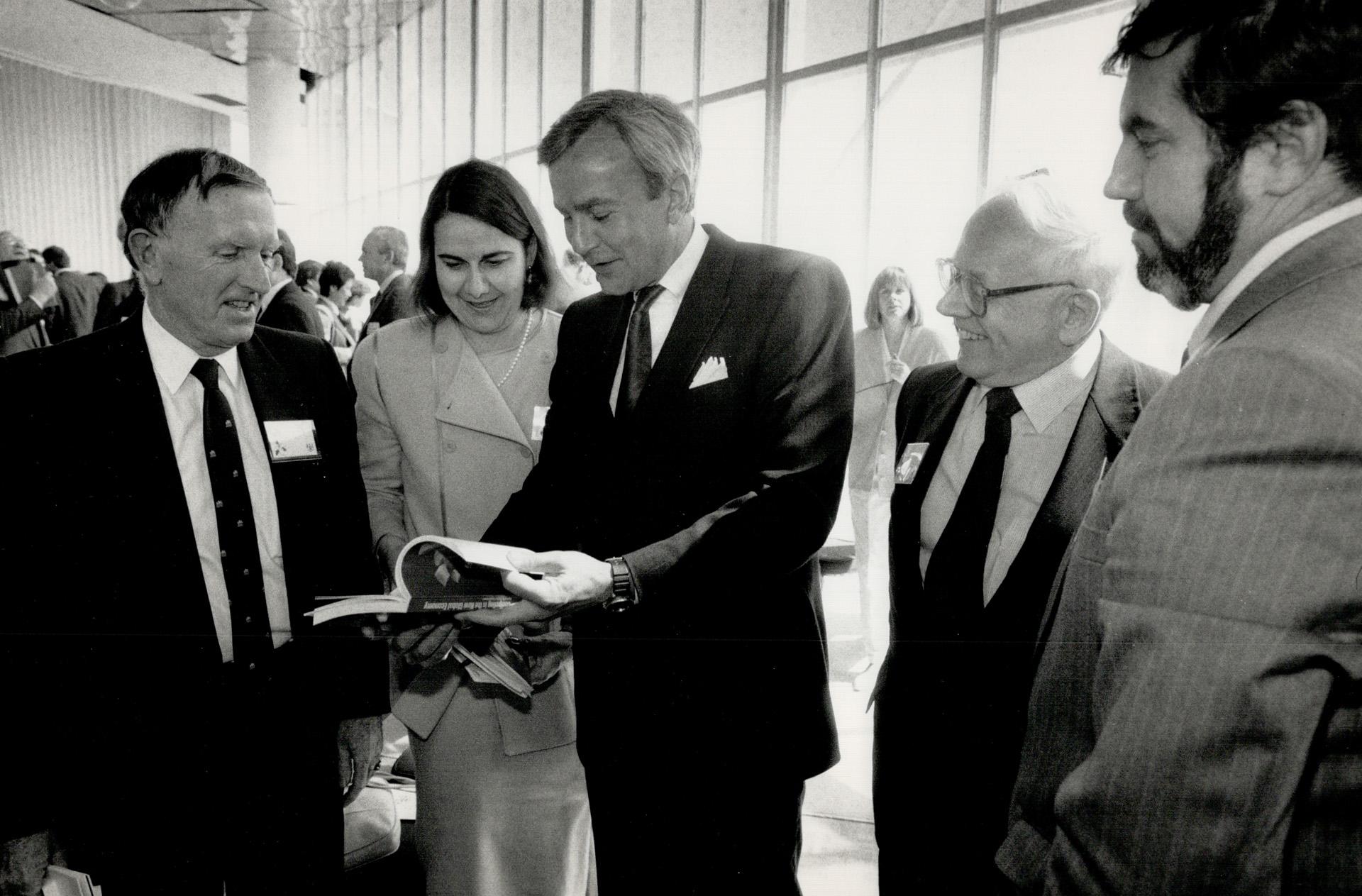
Competing in the new global economy: David Peterson’s landmark Premier’s Council
On the crest of his historic June 1985 election victory, Premier David Peterson decided that the province needed a new economic strategy to position it as a competitive force in an increasingly global economy.
The Premier’s Council was established in the April 22, 1986 Speech from the Throne with a mandate to steer Ontario into the forefront of economic leadership and technological innovation. This high-powered multipartite advisory body would be chaired by the Premier and composed of key cabinet ministers and heavy hitters from business, labour and academia.
Early on, the Premier demonstrated the importance of this effort by creating a $1-billion Technology Fund to support leading edge companies and initiatives to fulfill this vision. He also committed personally to invest his time by chairing every meeting and making Ontario’s economic strategy a top priority for his government.
One of the signature achievements of the Premier’s Council was introducing a common language that bridged the gap between the private sector and trade unions. The labour leadership at that time was not comfortable with the term productivity, assuming that this was about work speed-ups, faster production lines and, ultimately, cutbacks. But the Premier’s Council re-framed the discussion so that it was about increasing wages by getting higher value-added productivity per employee, by working smarter, by employing capital more effectively, and by getting higher prices for our products.
This new and more positive approach allowed council members like Leo Gerard, Canadian head of the United Steelworkers of America, to agree with Paul Phoenix, then-president of Dofasco Inc., that labour was a vital partner in boosting productivity.
Premier Peterson had set the ground rules for productive discussion by urging everyone to “check your special interests at the door.” This consensus-building approach was unique in its day and proved very effective in arriving at a commonly held view.
The Council agreed early on that Canada, and especially Ontario, could no longer rely on low-cost raw materials or on being wage-competitive with countries like China. Instead, our future prosperity relied on developing a knowledge-based innovation economy. What is common wisdom today was cutting-edge thinking in the late 1980s.
A focus on global competitiveness
One of the key tasks of the Premier’s Council was to analyze provincial industries to assess their global competitiveness, looking beyond just the domestic and U.S. markets. They also considered government economic policies such as tax barriers and business location incentives to see how competitive and effective they were.
To grow more Canadian-based multinationals, the Council focused on “threshold companies” with sales in the range of $40 million to $500 million, and with a significant exports. Often these flew under the radar, were under-capitalized and endangered by their own creativity, since the cost of launching a new product might mean betting the company.
The Council identified some 25 promising companies that were poised to become strong global players. Among them was auto parts manufacturer Magna International, which ultimately became a major multinational and Canadian success story.
Despite the focus on consensus, the Premier’s Council had its share of disagreements as well as triumphs. When the fractious free trade debate threatened to split the group, Premier Peterson declared the “Free trade is off the table. I know some of you have strong views, and I’ll talk to you about those in private, but what we’re achieving here is too important to be undermined or sidelined.” Everyone accepted that decision and put clashing views aside to focus on how to make Ontario an economic powerhouse.
Recommendations for competing
Nothing like the Premier’s Council report had ever been conceived or written before, and there was a lot of back and forth on what to name this groundbreaking study. Again, it was the Premier who cut through the debate and named it Competing in the New Global Economy.
The 250-page report was completed in 1988 and offered 14 recommendations. Among them was an Ontario Recapitalization Incentive Plan to support home-grown, mid-sized exporting companies; an Ontario Risk Sharing Fund for matching loans for product development for export; tax and other incentives to encourage investment in promising ventures; and incentives to stimulate research and development.
When developing the concept for what would become the Centres of Excellence, the Council asked what companies with deep capability already exist here in Ontario and how they could be linked with post-secondary research expertise . To be a Centre of Excellence, sector partners had to demonstrate that they were both leaders in new technologies and prepared to co-invest.
Based on the Council’s recommendations, the Peterson government created an open competition, led by a high-powered international panel, to evaluate proposals. Out of this emerged seven Centres of Excellence, several of which are still operating today under the Ontario Centre of Innovation (as the Ontario Centres of Excellence were renamed in 2020), a non-profit corporation that supports research, innovation and commercialization in the province.
The Council also recommended an Ontario Centre of Entrepreneurship, an R&D tax incentives program, and early-stage venture capital initiatives. Offshoots of each of these initiatives continue to this day.
The need for new skills
The second Premier’s Council report, People and Skills in the New Global Economy, would recommend mechanisms for restructuring companies, retraining workers coping with technological change and investments in education, skills upgrading and lifelong learning.
The reports of the Premier’s Council, considered groundbreaking in their day, still form the backbone of economic policy today. Underlying the recommendations were some fundamental and timeless public policy objectives, including encouraging companies and industries to move to higher value-added per employee activities; focusing industrial assistance on businesses and industries in internationally traded sectors; and promoting a more entrepreneurial, risk-taking culture.
The success of the Council’s work relied heavily on the Premier’s commitment to and engagement every step of the way. He attended every meeting and engaged in every discussion. When Competing in the New Global Economy was released, he ensured that it immediately became government policy.
The Premier sent a copy of the report to Nobel laureate and economist Robert Solow, someone he much admired and whose ideas he deeply valued. He was delighted to receive back a personal letter from Solow stating that it was the best articulation of economic challenges and solutions that he had ever read.
The Premier’s Council’s model for the Centres of Excellence was later replicated in Europe and Australia, and the council itself became the subject of several academic theses on how to set economic policy.
During his time as Premier, David Peterson always maintained that the Premier’s Council was one of his most successful and enduring creations. He was right. It was indeed a model for creating common ground for government, industry and labour to work collaboratively in designing sound, durable and innovative government economic policy. That legacy continues to this day.