Beer and wine finally in corner stores – not so fast!
Complications were limitless. Despite broad public support at the polls, the issue fired up fierce opposition from political rivals, commercial players and public interest groups. Another obstacle facing the concept was the weight of history.
Beer and wine in corner stores was “the defining issue of the 1985 campaign,” according to one pollster of the day. It helped bring down the Tories and propel David Peterson’s Liberals into government in Ontario in 1985.
But it was not to be.
The party’s commitment to making beer and wine available in familiar mom and pop stores was a strategic, almost daring, policy initiative in the face of decades of inertia in the marketing of alcohol in Ontario.
But many hurdles confronted the upstart Liberal government, including a crowded two-year package of legislation to be passed with the cooperation of the New Democratic Party.
A token attempt by the minority Liberal government to pass the sale of beer and wine in corner stores into law in 1986 was predictably doomed to fail. It did.
First, some historical context: for decades, cross-province marketing of beer, wine and spirits had been fundamentally paternalistic, shaped by prohibition practices from the 1920s, 1930s and beyond. Control of distribution was seen as the perceived cure for the threats to society posed by alcohol.
The not-so-good old days
There was a time when the purchase of a case of beer required the juvenile practice of entering a monopolistic Brewers Retail outlet. The place was devoid of boxes or bottles of beer, hidden from display lest public mores be adulterated. Customers approached a counter, scanned signs of what was on offer, made a choice and paid the bill. From behind a wall, the purchase being processed might be heard before it eventually rolled out through the wall on a conveyor into grateful arms.
If a bottle of wine was on the menu – or a selection of harder stuff desired to grace an evening with dinner guests – a separate, sometimes lengthy trip to another challenging establishment was required. This place was run by an Ontario Government corporation well-named Liquor Control Board of Ontario. Like the forerunner of the Beer Store, its creation in 1927 marked the end of prohibition, specifically intended to bring some order into any potentially raucous enjoyment of alcohol. And, it did that well.
Again, no evidence of the inventories was dared displayed. Customers were provided a slip of paper from a clerk behind a wicket and selected a preference. The clerk – always a man – disappeared behind a wall that hid the hoard, before emerging with the goods to be hidden from public view in a plain brown paper bag. It had to be signed for before it was allowed to leave the store.
So committed were governments to their oversight responsibilities that “control” extended far beyond the nefarious purchase of a case of beer or chosen bottle of wine or spirits. Hotel beerhalls segregated men from “ladies and escorts,” admitted through separate entrances. The drinking emporiums would be closed for the dinner hour to protect the family against the loss of hubby’s pay cheques. Don’t try to buy a drink on Sundays, nor seek one at a sports event. And, don’t try to smuggle a bottle of wine into a picnic hamper. The government was watching.
A paternalistic path
The control ethos had deep roots. Even as late as the 1980s, government in Ontario followed the paternalistic path that had been trodden throughout the post-prohibition era. Unlike Canadien neighbours across the Ottawa River, where you needed only to stop by the local grocery store to stock up (and don’t try to bring it back across the border), citizens from Cornwall to Windsor to Wawa needed supervision. Hours of operation were limited and inconvenient, especially for industrial and health care shift workers.
The system worked, almost too well, largely overseen by the Tories who had governed since 1943.
Meanwhile, the LCBO became an empire, one of the biggest buyers of booze in the world, later rivalling Costco in the United States and Tesco in Britain. And the Brewers Retail, eventually assuming the updated brand of Beer Store, also flourished.
So did government revenues and jobs. Therefore, so did the government’s dependence on the system and resistance to change. Meanwhile, public frustration grew, perhaps fueled by the post-war immigration boom that swelled and diversified Ontario’s population with citizens from less restrictive cultures. Italian immigrants were seen growing grape vines in their backyards.
Along came the Ontario Liberal Party under the leadership of David Peterson.
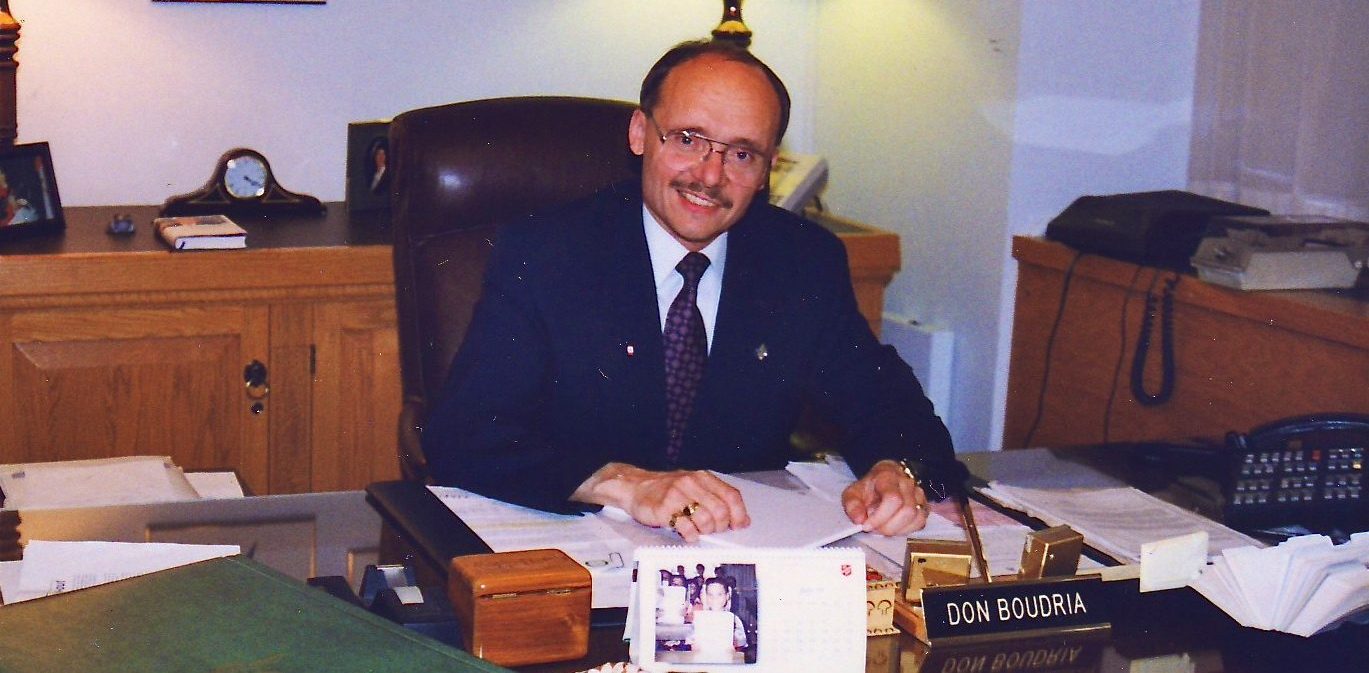
Latent stirrings within the Liberal Party against the system of marketing beer, wine and spirits in Ontario surfaced publicly when Liberal backbencher Don Boudria – later to establish a career in Parliament – dared to move a private member’s bill in the early 1980s proposing that corner stores be empowered to sell beer and wine to their customers, a revolutionary concept at the time. The Boudria bill was driven in part by the proximity of his Eastern Ontario riding (Prescott-Russell) and easy access to alcohol in neighbouring Quebec.
The lure of Quebec
“I live four miles from the border of Quebec,” Boudria recently explained. “Need I say more…”
In those days, Ontarians were active participants in discouraged inter-provincial trade. They still are, making regular trips across the Ottawa River for cheaper beer and wine found in small and large outlets.
One Quebec entrepreneur opened a couple of outlets called the “Beer King” in Gatineau to serve the predominantly Ontario clientele. That trade still exists, says Boudria. “They go over in trucks,” according to the retired parliamentarian. “You can’t understand it if you live in Toronto.”
The Boudria bill sparked the predictable pushback, particularly from an outspoken prohibitionist William Temple. Elected municipally in a dry west end pocket of Toronto, Temple railed against the threat of demon rum and other intoxicants. Others warned of the economic disruption such an initiative would have. But the pushback failed to quell the public mood for change. The Boudria bill triggered an outpouring of public endorsements province-wide. Don’s mailbox overflowed.
Naivety about policy
As a newcomer to Team Peterson in the role of director of communications in 1982, I sensed a potential game changer here. I carried into the job some journalistic instincts that told me that beer and wine in corner stores could set the party apart in the arena of public opinion. So I seized every opportunity to remind our team of the Boudria bill and its broad public support. And as campaign planning for 1984, then 1985, geared up, my somewhat muffled encouragement increased. The response was lukewarm.
I reasoned that as a campaign plank it would work, isolating both the Tories as the operators and New Democrats (through the unions) as producers and salespersons of the system. It would serve, I argued, as a “wedge” issue. But within our ranks there was a quiet hesitation.
I was new to the policy-making process. Despite a long career as a journalist observing, chronicling and commenting on municipal, provincial and federal politics, I clearly lacked an understanding of the complexities of transforming concepts into legislation, and legislation into practice. My advocacy was based on a simple concept.
It failed to factor in such basic realities as loss of jobs with the shift in markets. How would the new distribution system work? What about regulation to prevent access by minors? What might happen to the successful Beer Store system that had become a world leader in the recycling of glass and metal? And what might such a revolutionary change have on public safety? Would incidences of drunk driving and public lawlessness increase?
The concept of beer and wine in Ontario’s mom and pop shops was open to criticism on a number of fronts. But it remained an issue easily grasped by the voting public and subject to considerable study before ultimately being adopted as part of the 1985 Liberal campaign. Conveniently, a two-week lock-out of employees at the major breweries in early 1985 also halted the flow of beer, adding to public sentiment in favour of change.
“Most people feel that the system is too cozy, too tight, and does not serve the consumer’s interest,” said Peterson. “We don’t have to be paternalistic any more. Ontario has come of age.”
Popular with voters
The party’s beer and wine position was reinforced by opinion polls. A young social scientist named Michael Marzolini, a self-described ‘kid with a briefcase,’ said his polling showed the public was warming to the provincial Liberals despite years in the wilderness. But “it was clear… that we needed something to make us different, and to represent change.” He and a colleague devised a number of possibilities: “symbolic change policies,” they called them. “Beer in corner stores was dynamite,” Marzolini recalled.
According to one man-on-the-street: “In Montreal, where I’m from, everybody goes to their corner store to buy beer, wine. So why not here?”
Marzolini’s unvarnished conclusion was that “the beer in corner store issue was indeed the defining issue of the 1985 campaign.”
So why wasn’t it implemented after the Liberals formed government?
For one thing, the plank commanded a relative low priority compared to ambitious measures contained in the Liberal-NDP Accord. Certainly, Bob Rae didn’t afford the policy any priority, nor did he see much public demand for it. His focus, if any, was on the lack of transparency behind price increases announced by the Big Three breweries – Molson, Labatt, and Carling O’Keefe.
A threat to public safety?
Other barriers included the potential collective impact on jobs and the environment. Still another was the theoretical threat to public safety. The Ontario Medical Association (OMA) and Mothers Against Drunk Driving (MADD) condemned the concept, claiming easy access would harm health and increase the number of drivers under the influence. (A counter argument was that driving distances between pickup at corner stores and home would in fact be reduced and the distances might even be walkable.)
Ann Vanstone, then chair of the Toronto Board of Education, offered the additional concern that: “I would find it very surprising if young people didn’t buy it and drink it, presumably at lunch hour.”
Municipal politicians also balked. The Association of Municipalities of Ontario (AMO) asked the government to ‘drop the idea’ following its August 1985 and 1986 conventions. Tourist areas saw the benefit of the freer flow of alcohol to appeal to American visitors, while other municipalities adopted a more conservative approach.
Meanwhile, divisions were also appearing among proposed retail outlets.
The Canadian Federation of Independent Businesses (CFIB) joined the debate, arguing that alcohol sales would help small independent grocers compete better with the grocery chains. Some felt that franchised corner stores should not be permitted, while others felt only true independents should be included.
Others want in
Some hoteliers, bars and motel operators called for off-premise sales at their sites to be included as an alternative to, or in addition to ‘mom and pop’ shops, since minors were not allowed in their establishments. But the Ontario Hotel and Motel Association warned of the risk of increased liability of sales at more outlets and accompanying drunken customer behaviour.
In the view of the Ontario Liquor Licence Board (LLB) and LCBO, dramatically more staff would be needed to process license applications and for the inspection of thousands of new outlets.
Throughout it all, the impact on prices for Ontario consumers was unclear. Consumers wanted to pay less, like citizens on the other side of the Ottawa River. Prices in Quebec where convenience store locations had operated for decades seemed lower. Yet, Brewers’ Retail representatives argued prices would rise up to $3 per case because of increased distribution costs. And internal government pressures to maintain revenue levels leaned toward holding the minimum price at LCBO and Brewers’ Retail levels.
An international trade issue
The issue also took on international consequences in 1985 when the European community, United States and Australian governments complained to the World Trade Organization (WTO) that Canada was violating terms of the General Agreement on Tariffs and Trade (GATT) because of existing provincial alcohol listing, distribution system, differential price mark-ups, and marketing practices in Ontario and other provinces.
Formal trade panels were struck in February 1986 to investigate. It was concluded that expanding Ontario alcohol sales only into corner stores would exacerbate the situation internationally and with interprovincial partners as well.
Deputy Minister of Consumer and Commercial Relations Val Gibbons, was assigned the task of being Ontario’s lead negotiator with Canada and representative to the trade panels. In trying to make “reasonable efforts” to avoid violating international trade agreements, the deputy minister found the government between the proverbial “rock and a hard place.”
Finally a government bill
Nevertheless, in an attempt to fulfill its campaign commitment, Consumer and Commercial Relations Minister Monte Kwinter introduced legislation on October 16, 1986. The bill proved a ‘bit of a dog’s breakfast’ trying to appeal to all stakeholders and appeasing none.
What Kwinter proposed was a municipal option to opt in or out of loosened alcohol distribution. Permissible hours would be from 8 am to midnight daily, with Sunday sales subject to pending legal judgements about Sunday shopping. Corner stores and off-premise locations could sell if they became licensed.
Employees selling alcohol had to be over 18 years of age. Bars, hotels and similar locations could only sell Ontario 6- and 12-beer packs for home use. Mom and pop shops – individuals who owned less than 3 stores or who operated single franchised convenient stores – could sell Ontario beer and wine. The stores had to meet minimum food sale levels for eligibility.
Cases of 24 beer and foreign brands would remain the purview of Brewer’s Retail and hard liquor and foreign wine would be restricted to the LCBO. Prices could be no lower than those at the LCBO or Brewer’s Retail, but could be as high as the stores wanted.
The bill shed no light on how alcohol would be distributed to the proposed new outlets, to where and how empty containers would be handled for reuse or recycling, or what penalties there would be for sales to or by minors.
The outcome could be easily forecast in a minority government. While the bill received the obligatory first reading, Robert Fisher, CBC-TV’s Queen’s Park guru, observed: “Now it’s clear…the legislation won’t go much farther than that… beer and wine is a dead issue.”
Lacking a majority, the makeshift Liberal bill went down to defeat, 53-28 a couple weeks later on October 29, 1986. Observers drew conclusions from the absence of 20 Liberals when the vote was cast. The premier was also absent from the Legislature that day. And during the subsequent 1987 campaign that focused on Free Trade and gave the Liberals a landslide victory, Premier Peterson noted: “We have no plans to [re]introduce that [beer and wine in corner stores]. There are a lot more important things to do.”
You can’t always get what you want
The episode, however, had chastened those responsible for the sale of beer, wine and spirits in Ontario. Opposition to beer and wine in corner stores did not prevent major reforms to alcohol distribution. Under the threat of major shakeups, both the LCBO and Brewers Retail undertook major store and marketing changes. Paternalistic practices were abandoned with makeovers of all outlets and the addition of hundreds of new locations. Hours were increased as were product offerings and inventories.
Assuming its modernized “Beer Store” brand, six new outlets were quickly opened. Inside an increasing number of outlets, customers were now able to customize their own six-packs, and drive-through services were being contemplated. But a proposal to open Beer Stores in Toronto subway stations was taking things too far for Monte Kwinter’s liking.
Kwinter, in his next role at Industry, Trade & Technology, partnered with self-proclaimed ‘Minister of W(h)ine’ Jim Bradley of St. Catharines, and Jack Riddell at Agriculture and Food to invest $25 million in Ontario’s Niagara wineries to rip out old labrusca vines and replant vinifera varieties like chardonnay, riesling, cabernet sauvignon, and merlot to enhance quality and offerings. This 1987-88 program was designed to assist the industry in light of Free Trade’s challenges.
They also helped kickstart the (then voluntary) Vintners’ Quality Alliance (VQA) in 1988 with leading vintners like Don Ziraldo of Inniskillin to position premium Ontario wines against their European and California competition. Ontario’s VQA appellation has since been made permanent, legislated, and expanded to include BC. And, on-site wine sales at boutique wineries were expanded beyond Inniskillin’s 1974 license.
Craft brewing and brewpubs also took off increasingly after 1986 – such as Brick Brewing, Sleeman, Creemore, and Upper Canada Brewing – although their access to distribution through the Beer Store became an ongoing challenge and irritation for the government.
Subsequent governments responded further to a growing public pressure for distribution change. Customers found themselves being treated as adults, while halting steps were taken to offer beer and wine for sale in major grocery stores under Liberal government of Kathleen Wynne in 2015. It wasn’t the broad support originally intended for moms and pops; rather an acknowledgement that consumer convenience had to be addressed.
Which brings us to the decision by the current Progressive Conservative administration under Doug Ford to extend the sale of beer and wine in corner stores.
Predictably, it has renewed vigorous debate – once again a costly and controversial undertaking.
It has always been thus.