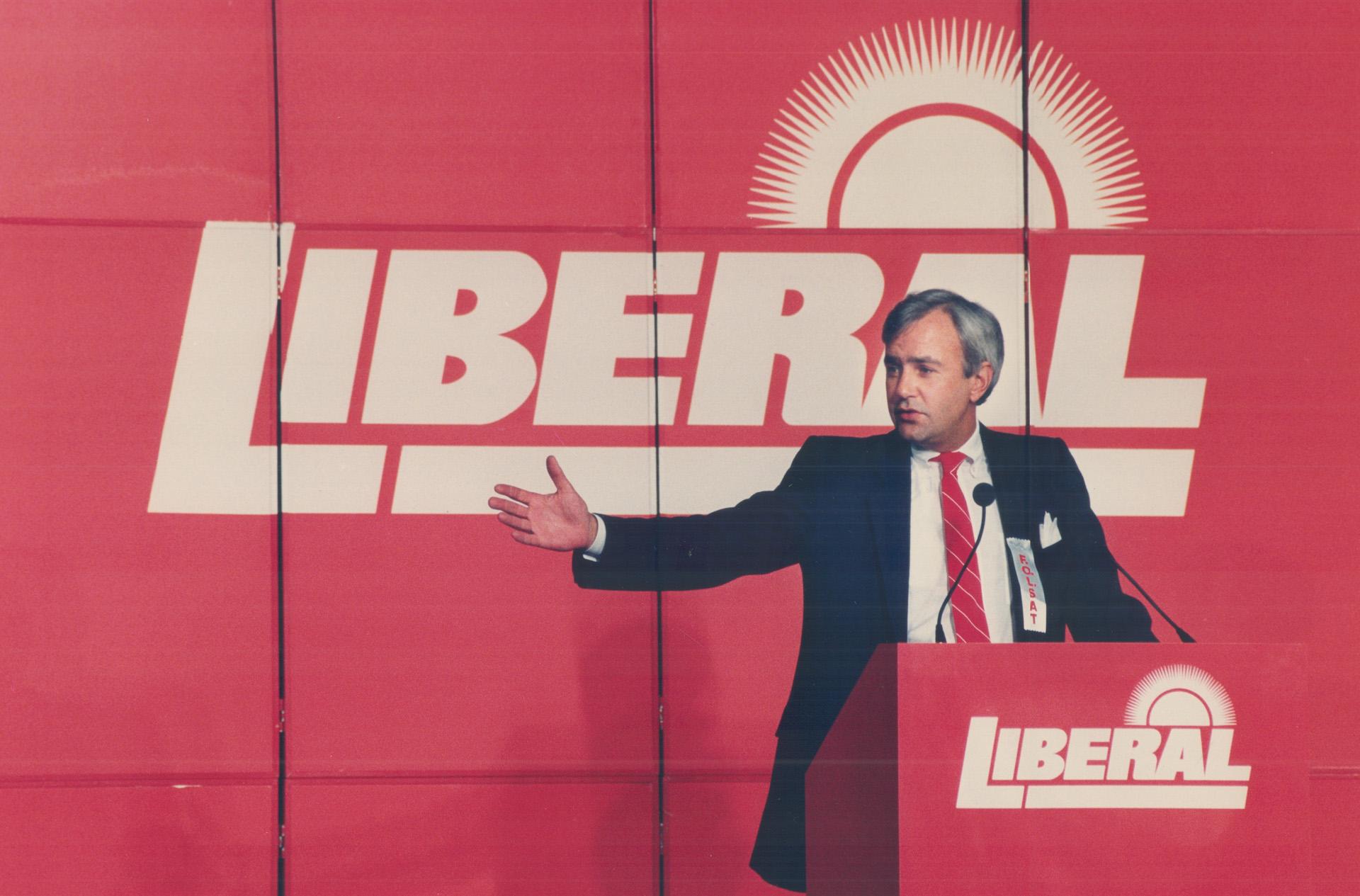
Reflection on David Peterson’s leadership
The unexpected is the nature of the political beast.
Apart from a handful of diehard party faithful, few in the run up to the 1985 provincial election expected David Peterson’s Liberals to become the Ontario government. While its subsequent historic electoral victory in 1987 was somewhat more predictable, even fewer Ontarians could anticipate the Liberals’ stunning fall from grace in the 1990 election.
While I was not surprised by the afterword, since winners regularly rewrite history, it has always rankled me that the Peterson years were swiftly relegated to a simplistic and in my view inaccurate summary: ‘an accidental government following another party’s agenda, only remembered for its electoral collapse’.
It is not how I remember that period.
Preparing to govern
The Liberal’s carefully crafted comprehensive agenda, researched and developed over three painstaking years, set out to meet the neglected needs of a contemporary Ontario. The platform encompassed in breadth and detail a great deal beyond what made it to the Accord. The Accord , itself a unique piece of governance, only contained common elements in both the Liberal and NDP agendas. The government’s multitude of achievements and initiatives in a short five year period, a number of which continue to be leading edge to this day, should be judged on their own merits.
No reminiscences about this 40th anniversary period is complete without reflecting on the impact of David Peterson. As his Chief of Staff from shortly after he became Leader of the Opposition and then Principal Secretary to his Premiership, between 1982 to 1988, I had a unique vantage point to watch his political career grow in action.
First impressions
We first met in early 1982.
I did not know what to expect when Peterson and I met in his Queen’s Park office. He had done his homework, checking me out with his old classmates who knew me in the foreign service. He demonstrated global work experience [in government, we drew upon that expertise freely during the Free Trade debate and the implementation of multiple Premier’s Councils] , strong Liberal social values implanted by his parents [formed his unwavering commitment to broad social welfare reform, youth employment and affordable housing initiatives] and a willingness to accept, value and work with people from all backgrounds [reflected by the appointment of Ontario’s first truly diverse cabinet]. I immediately related to his deep roots to family, and was captivated by his human touch, disarming frankness and willingness to take risks such as later dramatically reinforcing the Liberals’ move to an urban focus from their Southwestern Ontario Clear Grit roots.
But these qualities were wrapped up in a hard-nosed common sense business approach that defied ideological shackles, and a locker room sense of humour, which would sometimes get him in political trouble. Looking back, it seems almost counter-intuitive that Peterson, the seeming ‘frat’ boy, tie askew and rolled up shirtsleeves, would surround himself with strong and capable women Ministers, public servants and staff , whose opinions and challenges he valued. Competence always mattered to him more than gender, schooling or family tree. Under Peterson’s watch, the Tory patronage machine for even the most menial of jobs was doomed. Even Liberals were sometimes critical that patronage rewards were not automatically forthcoming, after such a long wait out of power.
Peterson’s perspective was non-Toronto centric, a refreshing change from many in the media and political world. That ultimately became reflected in his widely praised Northern strategy, as well as his commitment to move some provincial government offices out of Toronto to provide stable employment opportunities in other parts of the province.
Building on Peterson’s skills
The challenge would be how to take Peterson’s package of skills, experience and character and introduce him in an authentic way that could appeal to a broader cross section of the public. In particular, how could his team help Peterson overcome his initial lacklustre performance in the Legislature as compared to NDP’s talented leader, orator Bob Rae? Beyond naturally growing into the role provincially and nationally over time, Peterson was willing to submerge his ego and accept and translate advice about his own weaknesses, to the point that, through his own hard work, he transformed himself into a formidable campaigner and political communicator.
Arriving in Toronto the day after the Patriation Act was signed in Ottawa , I discovered there was much more to do to align with Peterson’s vision for the future than even I had anticipated from my research. His office team, to which he had recruited some personnel gems in communications, policy research and personal staff, was otherwise understaffed and under-skilled , lacked essential technical supports [ we still had rotary dial telephones and older typewriters and none of those new fangled computers]. Morale had been beaten down by successive electoral losses; a prevailing attitude to any suggestion started with ‘we have tried that already or it will not work’. Political staffing, fundraising and party organization would have to be rebuilt from the ground -up
In those early moments, I could only imagine Peterson’s skills and experience which would later blossom in his successful Premiership. Peterson accepted that delegation of responsibility unleashed creativity and commitment, important assets to counter our lack of Opposition resources but sometimes at the cost of control. He understood that politics required teamwork and a two way pledge of loyalty. That is ultimately how Peterson got so much out of his Cabinet and caucus as well as party members across the province whom he harnessed to his new endeavour. When the Minister of Environment wanted to take on acid rain or recycling, it was the conservation award winning youth from London who had his back as Premier.
Assembling a team
Peterson used his generous personality and persuasiveness to recruit candidates; he gave his team of strong Cabinet Ministers their head, while fully recognizing that some would do better than others. The challenge would be to stabilize wobbles before any of them became politically too damaging.
Peterson had the boundless energy of a younger politician, travelling the province non-stop to proselytize, recruit, fundraise and above all learn what he did not know about different regions’ challenges. Supported every step by the irreplaceable spark plug and party maven, Vince Borg, Peterson achieved real progress but under most radar screens. The party rebuilding was strengthened immeasurably later on by Gordon Ashworth and Pat Sorbara. A cable tv interview show , orchestrated by media master George Hutchison, and replayed at odd hours of the day and night, gave Peterson two valuable wins. For someone starting at single digit awareness shortly after being elected party leader, he achieved precious improvement in name recognition at a fraction of the cost of regular advertising and established priceless credentials with local media outlets. He also used it as a vehicle to recruit potential candidates.
In the wasteland of Ontario opposition, to challenge government consistently and effectively, Peterson was forced to rely upon the accuracy and understanding of his policy research team, who were themselves severely hamstrung by limited resources. It is to the credit of Tom Zizys , Phil Dewan and their accomplished colleagues, honed by Peterson’s relentless probing, that Liberal research documents became the source for so many provincial news stories of the day and the gold standard for accuracy.
Policy priorities
Combining that research capability to Peterson’s remarkable access to business network sources, led the Liberals to one of their most significant Opposition achievements, uncovering the Greymac Affair. In Question Period after Question Period for weeks, Peterson laid out new details of corruption based on original investigation and courageously ignored the scorn of the government and media who initially dismissed his efforts out of hand as irrelevant. Ultimately, his campaign forced action at both the provincial and federal levels; it also earned for Peterson and the Ontario Liberals bankable future credit with a previously skeptical press gallery.
In policy areas where he was less fluent, Peterson embraced the necessary private meetings with stakeholders , forsaking media attention in return for honest dialogue. He did his homework and his fluency on a variety of issues charted skyward.
Peterson wanted his team to own their mistakes and learn from them, not to be punished for honesty; like many others , I benefitted from his application of that standard. He was prepared to admit to public servants whose experience and knowledge the government needed that he had been wrong in accusing them of being hard core Blue in their approach. That is how a government which had no governing experience was able to win over and harness a skeptical public service to do their different bidding. Some leaders of that public service later called the Peterson years ‘their Camelot’.
Peterson was a keen student of political history. Canada’s changing political scene buoyed Peterson’s sense of hope that the Liberal days would come. In the darkest days of provincial Liberal fortunes, when a number of sitting members resigned to run for the Turner Liberals in the 1984 federal election, Peterson clung to the belief that a change of government in Ottawa would lead to upsets in Ontario as well. This was the consequence of the usual yin and yang of federal -provincial representation.
On the federal-provincial stage
On the two transcendent national issues of his day, Free Trade and Meech Lake, Peterson passionately promoted a federalist agenda for Ontario that was sometimes at odds with the central government.
Peterson’s opposition to the initial free trade agreement was both practical and prescient. As a businessman, he welcomed a good deal; the one being negotiated in the 1980’s was not, as the subsequent forty years of tariff dramas over softwood lumber, dairy, decreasing car manufacturing managed trade and the hollowing out of Canadian industry clearly demonstrated. The dynamics of Canada-USA trade was an existential one for Ontario, Canada’s manufacturing heartland. While Peterson became the rallying point nationally for those opposed to free trade, his position was much more nuanced, seeking substantial improvements to the treaty. That translated into a major effort, decades before the thesis became popular, to diversify Ontario’s trade in Asia and Europe, opening up opportunities which would require the private sector to embrace.
If Peterson and Mulroney remained at odds over Free Trade, including a memorable unscripted showdown at a First Ministers’ Conference, they collaborated closely together on the role of Quebec in Canada. That subject had remained close to Peterson’s heart from his time as a university student studying immersion french and then participating in conferences on the province’s future.
Knowing Bourassa, and using the promotion of french language rights and french usage in Ontario , provided the real bona fides of Peterson’s credentials to be welcomed at that table. As an issue of principle, Peterson refused to stop promoting solutions to the unresolved business relating to Quebec following the patriation. He was prepared to risking personal and party political capital time and again in the name of making Canada whole.
Implementing the agenda
Implementing the broader Peterson agenda was not for the faint of heart. The need to act quickly and on many fronts was at the core of the Peterson years.
Peterson understood that his own popularity was ephemeral. As he prophetically told his own caucus right after the 1987 landslide, he might have had carried them to victory this time but next election, they might have to win it in spite of him. A government acting ‘without walls or barriers’ also made itself more vulnerable to criticism and unmanaged expectations. Critics were ironically aided by newly introduced FOI and Privacy legislation, as well as a groundbreaking independent integrity monitoring system at the provincial level.
Issues were not ignored, just prioritized for action. Peterson wanted the smartest people in the room who could offer innovative solutions. In private, he would not tolerate status plays based on rank, much to the chagrin of any Minister, staffer or bureaucrat who tried to play those games- but never more than once. It had taken the Liberals 42 years to get into office again and every moment was precious.
Once a course had been set, Peterson expected action, not procrastination. He understood that governments acquire political capital to spend it, not to save it indefinitely. Some major policy items [separate school funding] needed to get done right away regardless of the complexity; or failure to act would subsequently overwhelm you. But he also exercised judgment about forcing issues linked to cultural values, such as Sunday shopping or beer and wine in the corner store. They sometimes needed more time to marinate in the public mind before definitive action could be taken.
No opponent was too strong to take on; government had to act with the broader public interest in mind. The end to extra billing after a brief, bitter doctors’ strike made that point crystal clear. No subject was taboo; the government’s support on gay rights legislation was an important moment in the human rights history of the Ontario legislature.
There should have been no surprise that a government forcefully moving ahead on social justice issues could also balance its budget books, a first in recent Ontario political history. That was the voice of the hard nosed businessman speaking.
The importance of symbolism
Peterson intuitively understood that even symbolic acts could make a tangible difference in the lives of Ontarians. Allowing the lighting of a Hanukah menorah at Queen’s Park, a first at the time, has opened the door to numerous other celebrations recognizing Ontario’s increasing non-Christian heritage. Nor was Peterson content to see the continuation of increasingly politicized ‘honours’ like the Queen’s Counsel designation in what should be a meritocracy.
In planning for Ontario’s future while meeting the needs of a contemporary Ontario, Peterson drew on his extensive business experience to set up Premiers Councils on the economy and education, health planning, and regional development councils. Understanding that any US FTA was only buying Canada time to diversify its trading patterns, multiple trade initiatives were launched in Europe and Asia respectively. He attracted major economic thinkers to challenge Ontario government and business influencers.
Peterson’s vision of an inclusive and dynamic Ontario ushered in an explosion of policymaking; his government made political policy debate fashionable again. His steely determination to attack the province’s contemporary challenges head-on, often overturning decades of prior government’s defence of the status quo, animated much of what his government initiated. His unwavering commitment to accommodating Quebec within a united Canada overturned conventional positions, established healthy new alliances while taking unprecedented political risks.
Peterson resuscitated the Liberal brand in Ontario; the many members he attracted to the party later became leaders in the political process at all levels. By breaking decades of one party rule, his government forced political realignments which have reinvigorated democracy in Ontario to this day.
In the end , Peterson’s government lost a gamble on an early election in 1990. Winning and losing are the only standardized measures in politics. True to his character, Peterson accepted personal responsibility for the electoral failure and handled defeat with an uncommon grace.
In an interview years later, he stated “My single greatest regret in politics is the failure of Meech, not the loss of the election”
Not a surprising epitaph coming from a leader who entered politics driven to address what mattered most.
