Protecting the Oak Ridges Moraine and GTA Greenspace: The Kanter Report
I was asked how I felt about Conservative government “stealing” my idea of protecting the Moraine. I was delighted: I believe that protecting the Moraine is good policy, regardless of who passes legislation to protect it.
In March 1989, I saw how sprawl was encroaching on maple tree forests in the Kleinberg area while sugar bushing with our family. As a backbench MPP from St. Andrew-St. Patrick, then a downtown Toronto riding, I wanted to try to protect important natural features, without stopping urban growth.
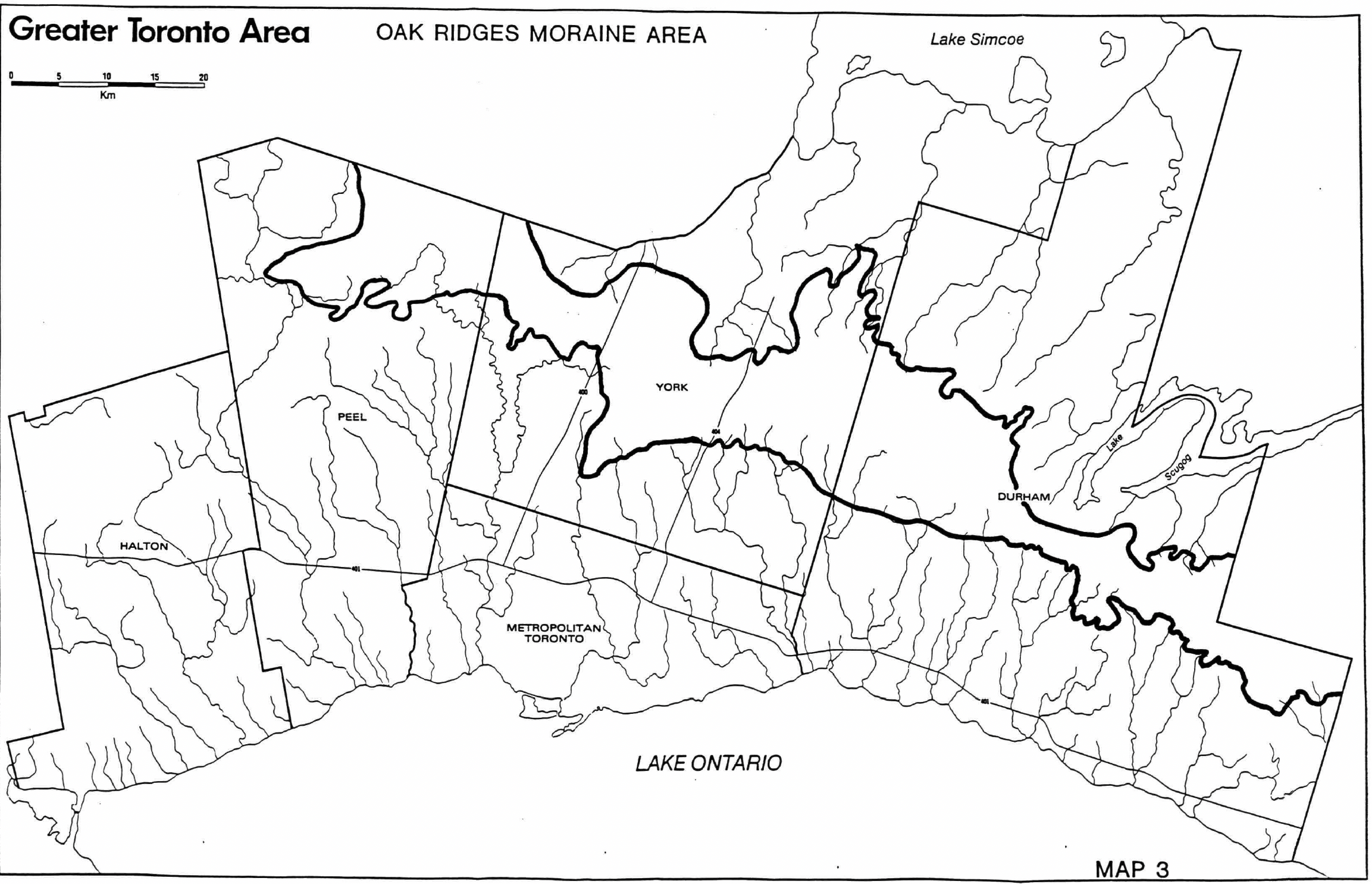
During the summer recess, I approached Premier David Peterson and proposed a study of natural features in the Greater Toronto Area. Peterson told me that he was about to appoint David Crombie to a joint federal-provincial Royal Commission on the Toronto Waterfront. I suggested I could complement Crombie’s work by looking at the regions bordering Lake Ontario: Halton, Peel, Toronto and Durham, plus York, which contained the headwaters of the Humber, Don and Rouge rivers.
In October 1989, the Premier asked me to conduct a study and recommend options for a Greenlands Strategy for the Greater Toronto Area. The Strategy was to provide a single regional focus to protect significant open space and natural areas early in the planning and development process. Two civil servants were assigned to help me conduct the study: Tom Farrell, from the Ministry of Natural Resources, and Laurie LeBlanc, from the Ministry of Municipal Affairs.
An intensive study
I spent the next seven months on an intensive study of the areas to be included in a regional greenlands system; mechanisms to secure, rehabilitate and enhance greenlands; and institutional arrangements to implement the strategy. The study included a review of existing reports; meetings with experts; and consultations with interest groups.
I learned, for the first time, about the role that the Oak Ridges Moraine plays in groundwater recharge and discharge into rivers such as the Humber, Don and Rouge. In one meeting, I asked hydrogeologists from U of T and Waterloo how long it takes for water to complete its natural cycle. I was told it takes about 5,000 years – I noted that was a very long time compared to the usual election cycle of 4 years. In other words, protection of the Moraine would require politicians to think far beyond the next election.
I met with representatives of existing and emerging community and environmental groups, such as Save the Oak Ridges Moraine (STORM), who were particularly concerned about development pressure on the Moraine. I also met with representatives of the development community, who expressed different concerns about the lack of certainty and consistency in the planning process. Some felt I might adopt a Communist approach to privately-owned land.
A visit to the regions
My preparation also included extensive visits to each of the 5 regions in the report, including the headwaters of the Credit River, various portions of the Oak Ridges Moraine, and the Durham Regional Forest. I particularly remember my visits to Halton Region, mainly in a small private plane piloted by Rash Mohamed, the Region’s Planning Commissioner. My stomach was feeling as “green” as the landscape after those visits.
In June 1990, I presented Options for a Greater Toronto Area Greenlands Strategy, to the Premier. The document, sometimes called the Kanter Report, contained 14 recommendations, as follows:
- The Province should endorse a regional greenlands system;
- Appropriate Ministries are to prepare guidelines addressing urban drainage, stormwater management and water conservation;
- Resource-based Ministries should protect lands based on their ecological value, rather than economic yield;
- The Province should prepare a policy statement to limit uses which would reduce the attributes of valleys and watercourses;
- Ontario is to declare the Oak Ridges Moraine an area of provincial interest, and review all official plan amendments and zoning applications within the Moraine;
- Regional Municipalities (Halton/Peel/Toronto & Durham) should ensure that all 30 local municipalities establish development, greenlands and rural envelopes;
- The Planning Act should be amended to prevent vegetation or topsoil removal prior to development approval
- The Conservation Authorities Act should be amended to regulate the placing or dumping of fill and waterway alteration from a conservation rather than hazard perspective;
- The Ministry of Environment should investigate ways to assess the water resources of a watershed or aquifer system to establish a water budget, including the amount of water available for water-taking;
- The Province should establish a GTA greenlands acquisition program in the amount of $100 million;
- The Province, regional and local municipalities, and conservation authorities should work together to implement the Greenlands Strategy, as well as the development of infrastructure within the GTA;
- The Trees Act should be amended to better protect trees and woodlots;
- All levels of government should promote more compact urban forms (intensive or higher density, rather than extensive or sprawl forms of development)
- The Province should establish a Greater Toronto Greenlands Foundation to provide public/private partnerships to protect greenlands, including incentives for landowners.
Premier Peterson called an election in 1990, which was won by Bob Rae, then leader of the New Democratic Party. Civil servants conducted some of the studies proposed by the Report, but the NDP did not take any political initiatives. In 1995, Bob Rae was defeated by Mike Harris, the leader of the Progressive Conservative Party.
“Stealing” my idea
In May, 2001 the PC government announced a 6-month moratorium on development in the Oak Ridges Moraine, and later that year, the government introduced the Oak Ridges Moraine Conservation Act, 2001, which aimed to preserve the moraine’s ecological and hydrogeological integrity. I was asked how I felt about Conservative government “stealing” my idea of protecting the Moraine (Recommendations 2, 5 & 9). I was delighted: I believe that protecting the Moraine is good policy, regardless of who passes legislation to protect it.
In 2005 the Ontario Liberal government led by Premier Dalton McGuinty passed the Greenbelt Act, 2005, which protected a broad swath of forests and farmland within the GTA from development. That addressed the protection of the second major natural feature identified in my Report (Recommendations 1, 3, 6, 10, 12 & 14). The McGuinty Government also passed the Places to Grow Act, 2005, which linked greenland preservation with urban development, and encouraged higher density rather than sprawl (Recommendations 11 & 13).
Pressure for land development
There is continuing pressure to develop land within the GTA, including lands with significant environmental features. However, I believe my Report was a seminal step in the process which helped balance development pressure and environmental protection in the GTA. Here’s what Andre Sorensen, Professor, Human Geography, University of Toronto says about it:
“The Kanter report “Space for All: Options for a Greater Toronto Area Greenlands Strategy” made two particularly important and timely contributions to regional greenspace planning in Ontario. The first was its identification of the Oak Ridges Moraine as the region’s salient geographical fact and environmental resource. With its thin soils, fragile ecosystem, and vast aggregate deposits, the ORM combined essential environmental functions as aquifer and headwaters of all rivers in the region with a great vulnerability to sand and gravel extraction. This report put the Oak Ridges Moraine ‘on the map’ in the public imagination.
A second major contribution is that by clearly identifying the need for and value of greenspace planning at the scale of the whole GTA, Kanter helped to trigger an important debate that led directly to the Oak Ridges Moraine protection Act 2001, the Neptis Foundation’s ‘Toronto-related region futures study’ of 2002 that detailed the high costs of continued sprawl, and the Greenbelt and Places to Grow Acts of 2005. The report in this way represented a major fork in the road that led to much more ambitious regional planning for the Toronto region.”