Preparing for the 1985 provincial election
In October 1984, Ontario’s political trajectory took an unforeseen turn.
Widely expected to call an election on Thanksgiving Monday, Premier William Davis instead announced his resignation, setting off a chain of events that would dismantle the Progressive Conservative (PC) dynasty, which had governed Ontario for 42 years. This surprise move ignited a period of intense political activity and transformation, ultimately resulting in the rise of Liberal leader David Peterson and the beginning of a new, more competitive era in provincial politics.
Davis’ resignation and the PC leadership race
William Davis’s decision to step down caught the political establishment off guard. Citing his unwillingness to serve a full term, Davis announced his retirement and called for a leadership convention in early 1985. This marked the beginning of a race among four prominent PC cabinet ministers: Frank Miller (Minister of Industry and Trade and former Treasurer), Larry Grossman (Treasurer), Dennis Timbrell (Minister of Agriculture and former Health Minister), and Roy McMurtry (Attorney General). Miller, representing rural Ontario and small-town conservatism, contrasted with Grossman, Timbrell, and McMurtry, who were all rooted in Toronto and reflected a more urban, moderate, and establishment-oriented wing of the party.
In a rare intervention, Davis encouraged the candidates not to deviate from official party positions on contentious issues such as rent controls, bilingualism, Suncor investment, and especially the full public funding of Roman Catholic schools—a divisive policy he had introduced in June 1984. This effort to constrain debate during the leadership contest underscored Davis’s intent to preserve party unity, though it also suppressed open discussion on key electoral issues.
Despite the controlled narrative, underlying party tensions persisted. Many backbenchers and grassroots Tories felt excluded from decision-making by Davis and the so-called “Big Blue Machine,” the party’s central campaign apparatus. Frank Miller capitalized on this discontent, positioning himself as a populist outsider. His campaign was better organized than his rivals’, and he led every round of balloting at the January 1985 convention, ultimately defeating Grossman on the third ballot with 52.3 percent support. On February 8, Miller was sworn in as premier.
Election preparation and the Liberal strategy
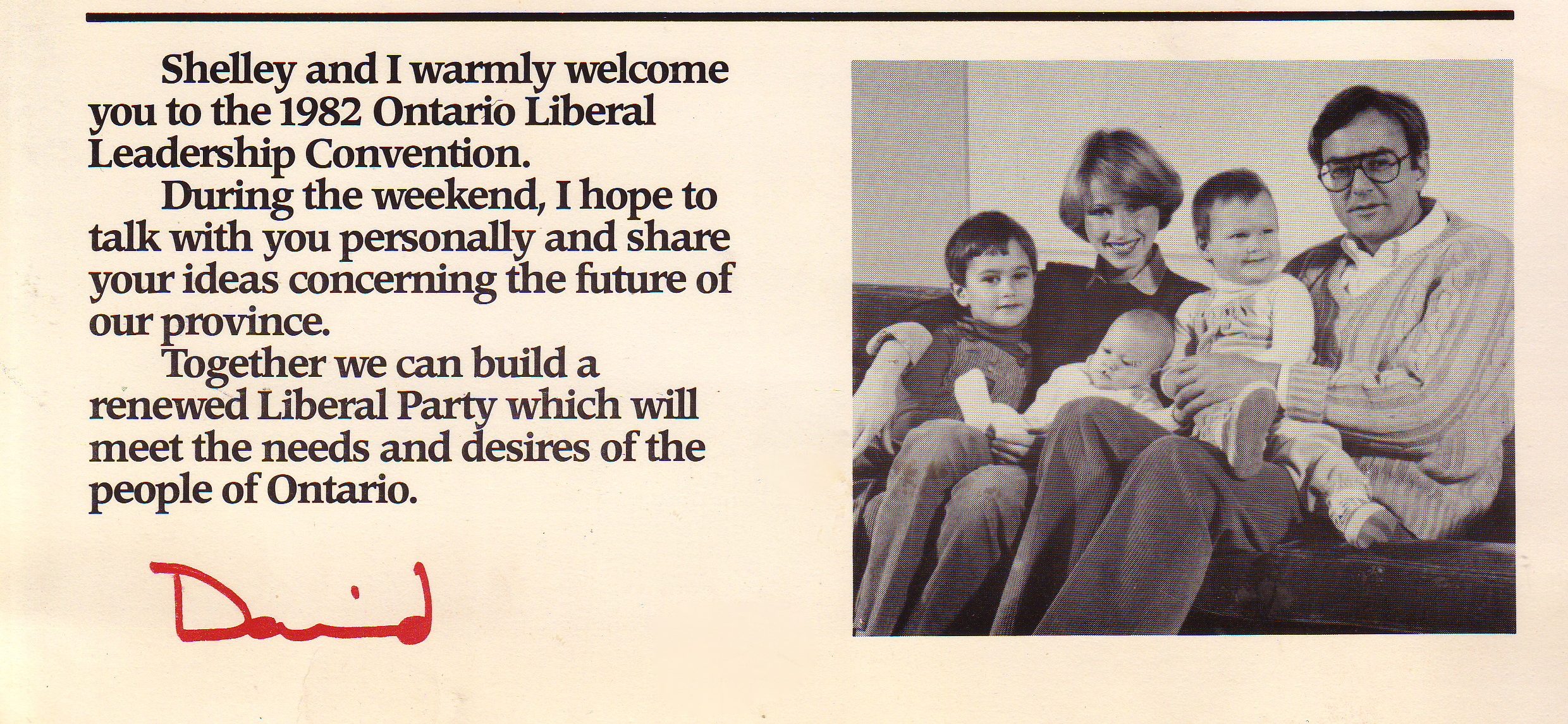
While the PCs were focused on their internal leadership battle, the opposition parties — especially the Liberals—were quietly and methodically preparing for an election. Since taking over as leader in February 1982, David Peterson had embarked on a comprehensive effort to modernize the Ontario Liberal Party. His aim was to reposition the party from a rural, largely conservative-leaning organization into a more urban, progressive, and demographically responsive force. Central to this transformation were three elements: revamping policy, refining communications, and rebranding Peterson’s public image.
Demographically, Ontario had changed dramatically during the Tory reign. From 1945 to the mid-1980s, its population more than doubled, becoming significantly more urban, ethnically diverse, and socially progressive. With increasing numbers of women in the workforce, a large and growing Roman Catholic population, and an influx of immigrants, the electorate demanded new political approaches. Peterson’s team, led by Hershell Ezrin and supported by researchers like Tom Zizys, worked to align Liberal policy and messaging with this evolving landscape.
Ezrin introduced modern campaign techniques, emphasizing polling and focus groups, and adopted a data-driven approach to shaping both image and message. Although Peterson initially mocked the Tories’ reliance on public opinion research, he too came to embrace it under Ezrin’s direction. Caucus-led task forces developed policy papers, known as “backgrounders,” that served as both internal guidance and public messaging tools. These documents were widely distributed to journalists and became essential references for the media, enhancing the party’s credibility.
Rebranding the Liberal leader
Peterson himself required transformation to become electorally viable. Though bright and policy-savvy, he struggled with the combative aspects of opposition leadership and lacked the rhetorical sharpness required to criticize government effectively. Communications director George Hutchison and TV producer Gabor Apor guided his public presentation. Peterson was reshaped into a modern political figure—fit, media-friendly, and photogenic. He began jogging, lost 20 pounds, wore contact lenses, and adopted a signature red tie as his political emblem, reminiscent of Pierre Trudeau’s red rose. These changes aimed to create a compelling visual and emotional contrast with the 57-year-old Miller, portraying Peterson as the energetic, urbane face of a new Ontario.
Polling by Goldfarb and Associates revealed that many voters—especially women, youth, minorities, and urbanites—felt neglected by the Conservative government despite an economic recovery. Based on this insight, Senator Michael Kirby, acting as a strategist for the Liberals, recommended that Peterson focus on social issues, craft bold policy proposals, and present himself as a champion of Ontario’s emerging middle class. Ezrin and his team distilled these themes into the campaign slogan: “Vote for Your Ontario.”
Public response to the Liberal platform
The 1984–85 period was not without setbacks for the Liberals. Several MPPs left provincial politics to run federally or pursue other roles. Federally, the party had been crushed by Brian Mulroney’s Progressive Conservatives in the September 1984 election. The Liberals also fared poorly in five December 1984 by-elections, further demoralizing the caucus. A Decima poll conducted after the PC leadership convention in January 1985 showed the Conservatives at 55%, the NDP at 20%, and the Liberals at just 18%.
Yet, rather than retreating, Peterson and his team leaned into their modernization strategy. At the party’s February 1985 annual meeting, he unveiled a progressive and ambitious platform. Highlights included:
- Banning extra-billing by doctors
- Eliminating OHIP premiums
- Legislating equal pay for equal work
- Creating 10,000 new subsidized childcare spaces
- Guaranteeing a first job for every young person seeking work
Additional proposals included dental care for low-income residents, environmental reforms, affordable housing initiatives, and permitting beer and wine sales in corner stores. The turnout at the February meeting—1,300 attendees, far exceeding expectations—suggested a groundswell of enthusiasm.
Much had been accomplished since Davis’ announcement in early October 1984. Liberal despair had been replaced by an election plan that seemed to capture public attention. The true test would the campaign itself which began in late March when Premier Frank Miller visited the Lieutenant-Governor to ask for dissolution of the Legislature. Ontarios would vote on May 2, 1985. Would the Progressive Conservatives 42 year reign continue?
